Key takeaways
- GATE 2027 runs on 6, 7, 13, 14, 20 and 21 February 2027 across 30 papers. The paper-wise schedule is not out yet, so plan for 6 February.
- New for 2027: a Robotics and Automation paper, Textile in XE as XE9, new XE/XH/XL codes and revised syllabi. Check your question bank against them.
- General Aptitude can be shared across CS, EE, ME and CE. Engineering Mathematics is 13 marks in all four, but each paper has its own maths syllabus. Full mocks stay separate per paper.
- A free public GATE mock with an instant report is one of the cheapest ways to meet next year's students.
It is mid-November. An online GATE institute in Pune has four batches: computer science, electrical, mechanical and civil. GATE applications closed in October, and the students now want mock tests.
The owner has about twelve weeks and a team that also teaches live classes. This post plans the test series from the institute’s side.
GATE 2027 in one table
IIT Madras is organizing GATE 2027. Everything below is from the GATE 2027 Information Brochure (revised 17 October 2026) and the GATE 2027 website. IIT Madras says the dates can still change.
| Exam days | 6, 7, 13, 14, 20 and 21 February 2027 |
|---|---|
| Sessions | 9:30 AM to 12:30 PM and 2:30 PM to 5:30 PM |
| Papers | 30 (a candidate may take one or two) |
| Duration | 3 hours, on a computer |
| Questions and marks | 65 questions, 100 marks |
| General Aptitude | 10 questions, 15 marks (5 of 1 mark, 5 of 2 marks) |
| CE, CS, EE, ME and 13 more | Engineering Mathematics 13 marks + subject 72 marks |
| Question types | MCQ, MSQ (one or more correct), NAT (typed number) |
| Negative marking | MCQ only: 1/3 for a 1-mark, 2/3 for a 2-mark question |
| Results | 19 March 2027 |
What changed from GATE 2026
- A new paper: Robotics and Automation (RA)
- Textile Engineering and Fibre Science is now section XE9 inside XE
- New paper codes for the XE, XH and XL sections
- Revised syllabi for most papers
The pattern itself (65 questions, 100 marks, 3 hours) did not change.
The revised syllabi matter most. A 2026 question bank can test dropped topics and miss new ones. Check every question against the 2027 syllabus before the first full mock.
Counting back from 6 February
The brochure says the paper-wise schedule will be announced later. Until then, assume your students write on the first day. From 16 November to 6 February is just under twelve weeks.
Twelve weeks to 6 February 2027
16 Nov to 13 Dec
Sectional tests
Topic tests per subject. One shared General Aptitude test a week for all papers, and maths tests per paper.
14 Dec to 10 Jan
One full mock a week
A full 65-question, 180-minute mock per paper every Sunday. A review class mid-week.
11 Jan to 6 Feb
Two full mocks a week
Two mocks a week with a review day after each. Ease off in the last few days before the paper.
Our suggested plan, not a GATE rule. Move it forward if your paper falls on a later date.
That is twelve full mocks per paper. Four papers times twelve is 48 full mocks of 65 questions, or 3,120 questions. Let one General Aptitude set of 10 serve all four papers each time, and it drops to 2,760.
One paper per batch: keeping CS, EE, ME and CE mocks separate
General Aptitude is 15 marks with one syllabus for every paper, so share it. Engineering Mathematics is 13 marks in all four papers, but the brochure’s syllabus (Appendix D) gives each paper its own maths. CS includes discrete maths; CE, EE and ME have differential equations instead, and CE and ME add numerical methods. Share the common topics (linear algebra, calculus, probability) and keep the rest paper-wise, along with the other 72 marks.
- Put each paper's students in their own batch.
- Assign each full mock to one batch only. A CS student should never see an ME mock in the list.
- Assign the weekly aptitude test, and maths tests on the common topics, to all four batches.
- Compare results within a batch. Rank and percentile in the report are within the group, not all-India.
Running more than one GATE paper online? See how batches, a shared aptitude bank and paper-wise mocks fit together in one Vacademy institute.
Building a mock in Vacademy
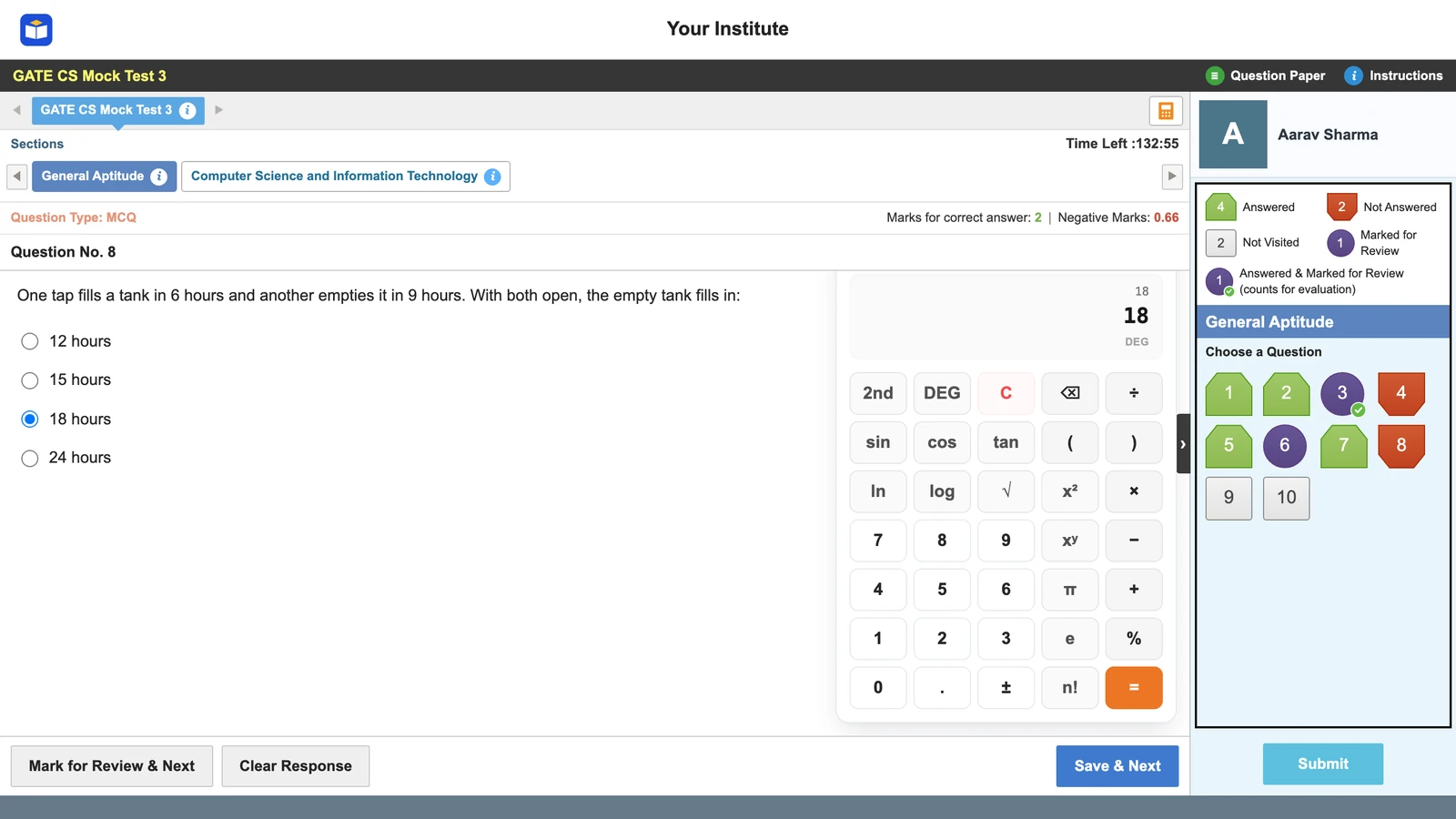
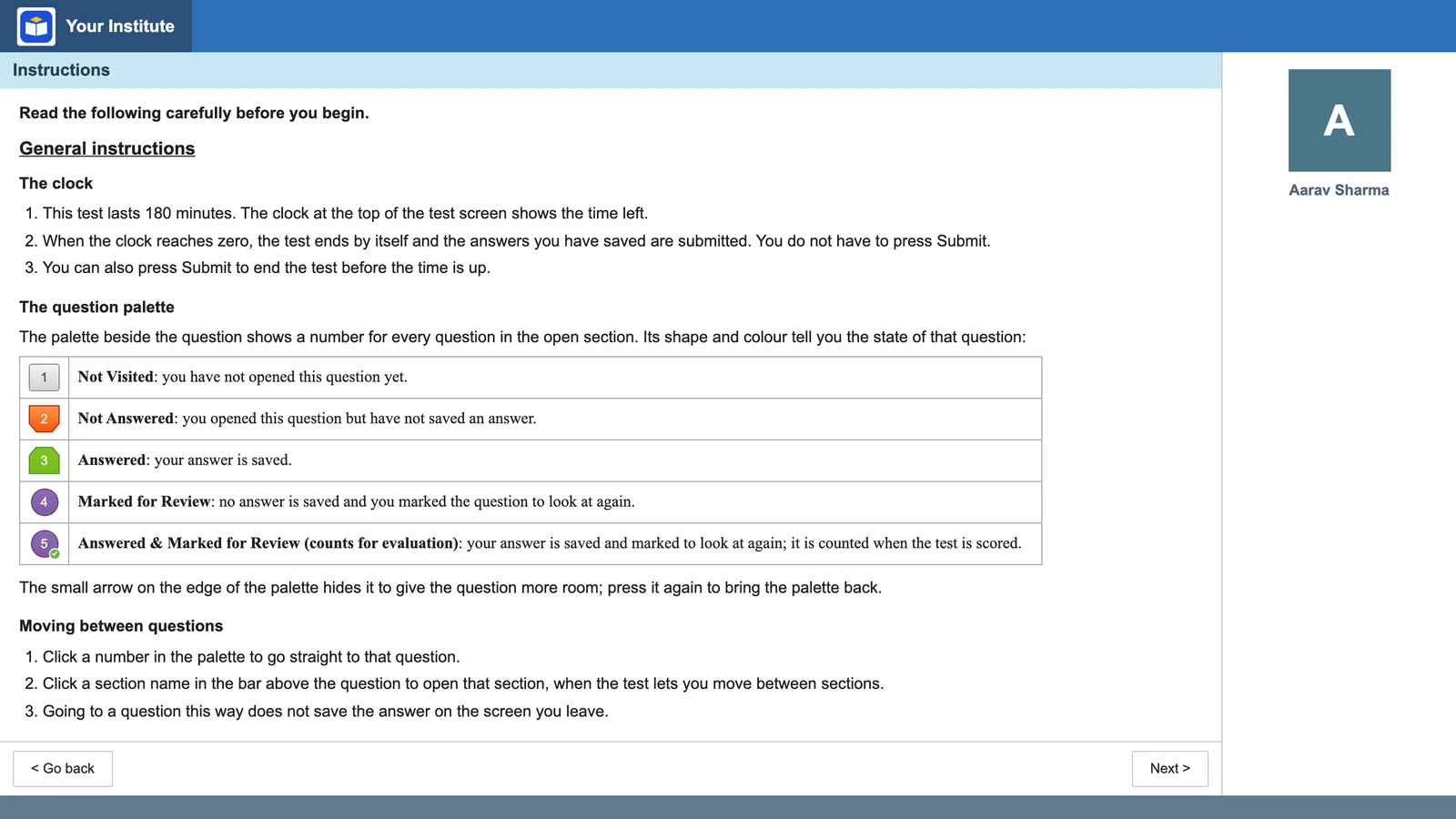
Students see a two-page instructions screen first, in Vacademy’s own words. Phones work too, with the palette as a bottom sheet, but push for a laptop on mock Sundays. GATE is taken with a mouse.
One caution: GATE’s marking is specific (no partial marks in MSQs, NAT answers correct within a range). Check the marking on a few sample attempts before the series starts.
A free public GATE mock as an admissions tool
Next year’s candidates are still in college. They search for free mocks, and they do not know your institute yet.
From a free mock to an admission
Open it publicly
Make one GATE-style mock public and share the link with guest students.
Report at once
Each student gets a report right after submitting: score, weak topics, rank in the group.
Track the lead
The built-in CRM tracks leads by source and runs follow-up workflows.
Call with the report
Your counselor calls about the weak topics, not with a sales script.
Ask us in the demo how a free-mock campaign connects to the CRM for your institute, and see the coaching CRM comparison and India’s coaching industry in 2026. Point every student to the official mocks too: the 2027 links will be on the GATE website, and the 2026 mocks are still online.
Six signs your GATE test series needs a rethink
- Your full mocks still follow the 2026 syllabus.
- CS, EE, ME and CE students get the same full mock.
- Students type numerical answers on a keyboard.
- Students can submit a full mock after 90 minutes.
- Nobody looks at time per question after a mock.
- Your free mock asks for a phone number and nobody calls.
Two or more ticks? The fix is a planning call, not a new syllabus. See how teachers build assessments in Vacademy, or read about the NAT keypad and virtual calculator.
Questions institutes ask
When is GATE 2027?
On 6, 7, 13, 14, 20 and 21 February 2027, in a forenoon and an afternoon session, per IIT Madras. The paper-wise schedule will be announced later on the GATE 2027 website. Results are due on 19 March 2027.
What is new in GATE 2027?
A new Robotics and Automation (RA) paper, Textile Engineering moved into XE as section XE9, changed paper codes for XE, XH and XL, and revised syllabi for most papers. The pattern stays at 65 questions, 100 marks and 3 hours.
How many mock tests should a GATE 2027 test series have?
There is no official number. A plan that fits the twelve weeks from mid-November to 6 February is sectional tests first, then one full mock a week, then two a week in the last month, per paper.
Can one test series serve CS, EE, ME and CE students?
Partly. General Aptitude (15 marks) is common to every paper, so it can share a question bank. Engineering Mathematics is 13 marks in all four, but each paper has its own maths syllabus: CS includes discrete maths, while CE, EE and ME have differential equations. Share linear algebra, calculus and probability, and keep the rest and the other 72 marks paper-wise, with separate full mocks for each paper.
Can I run a free GATE mock test for students who are not enrolled?
Yes. In Vacademy, an assessment can be opened publicly and the link shared with guest participants. Each student gets a report right after submitting, and Vacademy's built-in CRM is there for lead tracking and follow-up.
Is Vacademy's GATE-style screen the official GATE interface?
No. It copies the layout and behavior of the computer-based exam, with your institute's logo and name. Vacademy is not affiliated with GATE, the IITs or TCS, and shows none of their logos.
Try Vacademy for your GATE 2027 series
Bring one of your old GATE papers to the demo. We will upload it while you watch and show it as a GATE-style mock.