Key takeaways
- JEE Main 2027 ends on 7 April. JEE Advanced is on 23 May. Students switch screens in about six weeks.
- The console family is the same: five palette states, Save & Next, an on-screen keypad. The exam inside it is not.
- The two traps are multiple-correct questions with partial marks, and numerical answers to two decimals.
- Run JEE Main-style tests until April, then switch new tests to JEE Advanced style. The screen is chosen per test.
JEE Main 2027 Session 2 runs from 2 to 7 April 2027. JEE Advanced is on 23 May 2027. Indian candidates must be in the top 2,50,000 of JEE Main to sit it. So a student who qualifies has about six weeks to change exams.
Take a student in Jaipur who has done forty JEE Main mocks. She knows that screen by heart. On her first JEE Advanced paper she ticks three boxes on a question with two correct answers, and types 4 where the key says 4.25. Her physics was fine. Her habits were from the other exam.
Same family of console, different exam
A lot carries over. In both exams the keyboard is disabled and answers are entered with the mouse. The palette shows the same five states: Not Visited, Not Answered, Answered, Marked for Review, and Answered & Marked for Review. The JEE Main bulletin and the JEE Advanced brochure both say a palette jump does not save the current answer. Only Save & Next does.
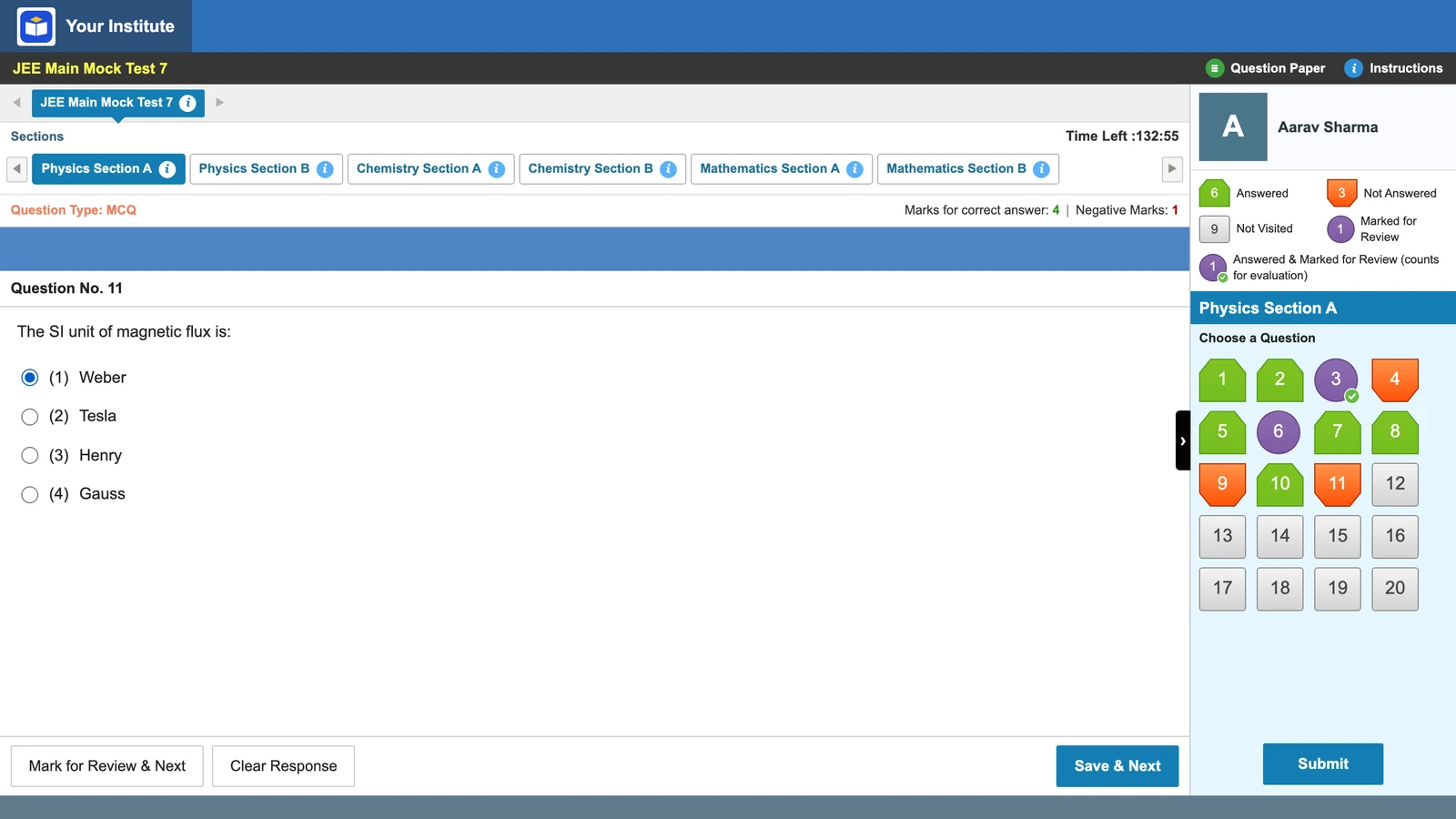
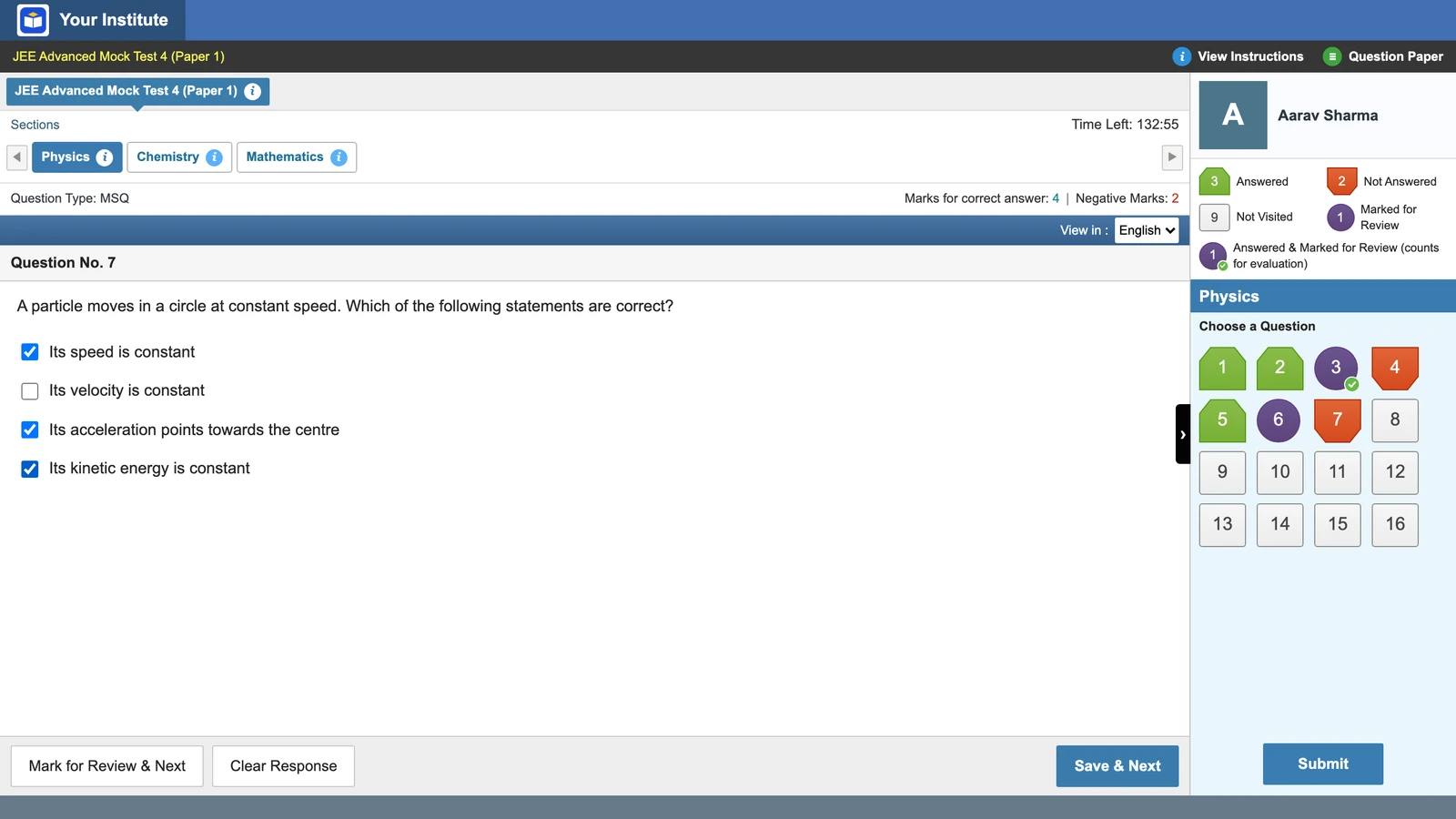
Same palette, same buttons. Look at the marks row and the answer boxes, though.
Seven differences students notice
Official rules compared
JEE Main 2027 vs JEE Advanced
| What | JEE Main | JEE Advanced |
|---|---|---|
| Papers on the day | One 3-hour paper | Two 3-hour papers, both compulsory |
| Section tabs | Six: Section A and Section B for each subject | Twelve in Paper 1, nine in Paper 2 (2026 mock) |
| Question types | Single-correct and numerical | Single-correct, multiple-correct, numerical, matching list |
| Marks | +4 / −1 on every question | Different in each section: +3 / −1, +4 / partial / −2, +4 / 0, +4 / −1 |
| Numerical answers | Whole number; wrong answer −1 | Value to two decimals; wrong answer 0 (2025, 2026 mock) |
| Language | English plus one chosen language, switched for the whole paper | English or Hindi, switched for any question |
| Buttons | Bulletin: Save & Next, Mark for Review & Next, Clear Response. NTA's web practice mock adds Back, Next and Save & Mark for Review | Three: Mark for Review & Next, Clear Response, Save & Next. No Back |
JEE Main from the 2027 bulletin, except the Buttons row, which also describes NTA’s web practice mock. JEE Advanced from the 2025 papers and the 2026 official mock; the 2027 pattern is not out yet.
The button row is a quiet one. Some JEE Main practice mocks, including NTA’s web mock, add Back and Next buttons. The bulletin’s exam instructions do not mention them. Students used to a Back button will look for one, and the JEE Advanced console has none. To go back, they use the palette, and the palette does not save.
Multiple-correct and partial marks: the rule students misread
JEE Main never asks for more than one option. JEE Advanced does, and it pays for partly right answers. Under the 2025 rules, take a question where B and D are correct:
Multiple-correct, 2025 rules
Sure of one? Tick one.
2026 reports: exam-day reports from coaching institutes (eSaral, ALLEN) say the live 2026 papers took −1, not −2, for a wrong pick. The official 2026 papers are not yet in the archive, so check the 2027 mock.
A JEE Main habit says “pick the best option”. Here it should be “tick only what you are sure of”. One extra guess turns +1 into −2.
Numerical answers: whole numbers vs two decimals
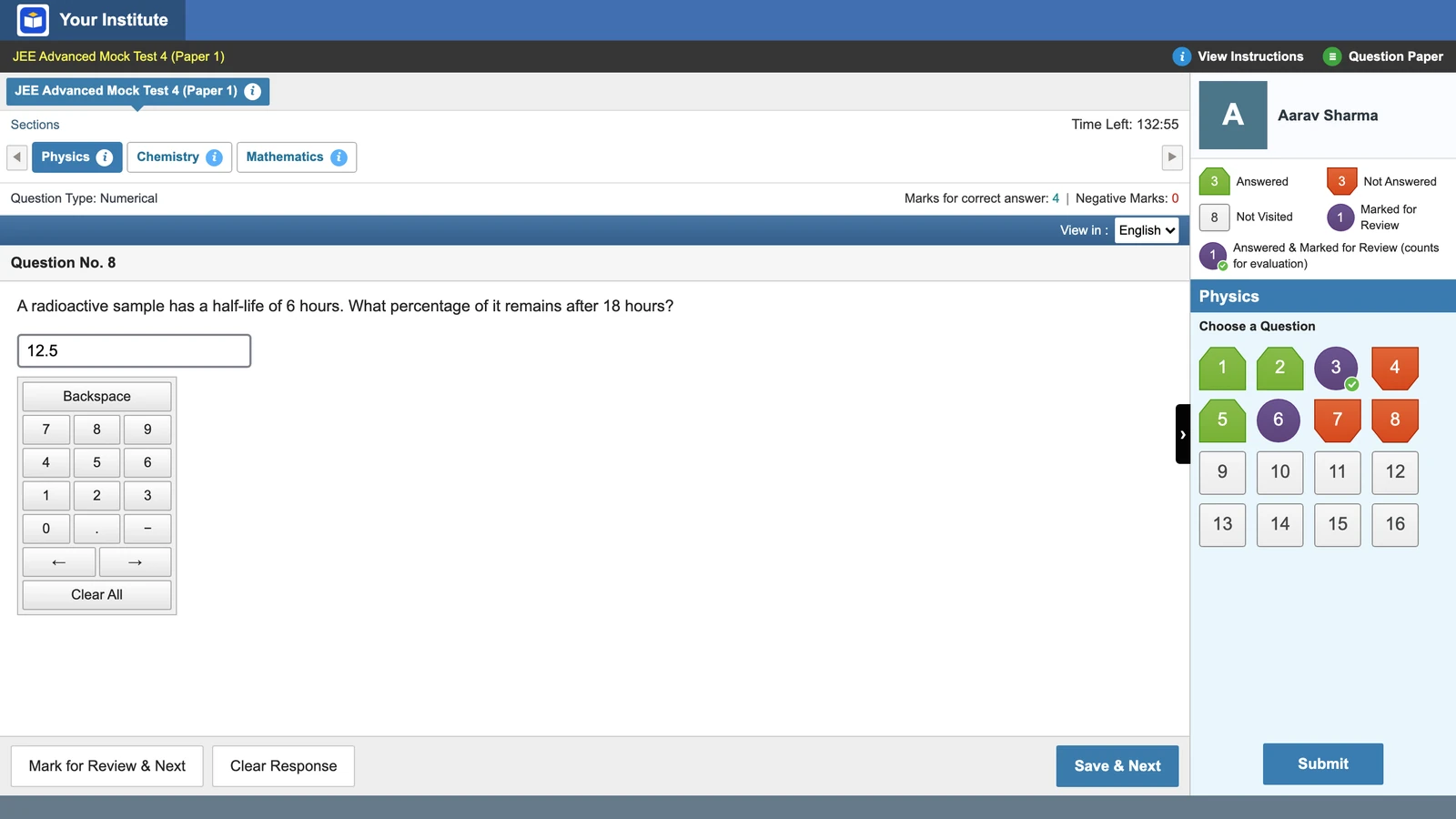
In JEE Main, a numerical answer is rounded off to the nearest integer, and a wrong one costs a mark. In the 2025 JEE Advanced papers, students “truncate/round-off the value to TWO decimal places”, and a wrong answer scores zero. So 4.25 is not 4, and a guess costs nothing in that section. On Vacademy, numerical questions use an on-screen keypad with a decimal point and a minus key.
A two-week switch plan for your batch
This is our suggestion, not an official schedule. Start it the week after the April JEE Main papers.
Our suggestion
Fourteen days from JEE Main habits to JEE Advanced habits
For the full two-paper day, see running JEE Advanced full mocks. For using AI to fill the gaps the reports show, see how AI can improve exam prep and agentic AI for competitive exam coaching.
Setting it up in Vacademy
On Vacademy the exam interface is picked for each test, on its first step. Through April, set JEE Main tests to JEE Main style, in the NTA mock layout or the TCS console layout. From mid-April, set new tests to JEE Advanced style. Both kinds can run in the same week, so a batch can move across gradually.
Two modes help the switch. “Strict saving like the real exam”, on by default, counts an answer only after Save & Next or Mark for Review & Next. Practice-friendly mode saves every click and always allows Submit. Use it for the first drills, then turn strict saving back on.
See the same question on both screens
We will show one test in JEE Main style and the next in JEE Advanced style. The screen is one setting on each test.
What it does not do yet
Vacademy’s screens do not have the per-question English and Hindi switch, so Hindi-medium students cannot practice that part. And there is no one-click JEE Advanced pattern: your team sets up the sections and marks for each paper by hand. Partial marks on multiple-correct questions are given in proportion to the correct options picked; Vacademy does not yet apply JEE Advanced’s exact +3/+2/+1 rule.
Self-check
Your batch is still on JEE Main habits if...
- Students tick every option that looks possible on multiple-correct questions.
- Numerical answers come back as whole numbers when the key has decimals.
- Students look for a Back button and lose answers by jumping through the palette.
- Nobody can say the marks for each section without looking.
Questions JEE teachers ask
Is the JEE Advanced exam screen the same as JEE Main?
The basics are the same: a question palette with five states, Save & Next to save, and an on-screen keypad. JEE Advanced adds more section tabs, multiple-correct checkboxes, decimal answers and a different mark on each section.
How much time is there between JEE Main and JEE Advanced 2027?
JEE Main 2027 Session 2 runs from 2 to 7 April 2027 and JEE Advanced is on 23 May 2027. That is about six and a half weeks from the last JEE Main exam day.
Does JEE Advanced have partial marking?
Yes, on multiple-correct questions in the 2025 papers and 2026 mocks. Picking only some of the correct options earns +1 to +3. Picking any wrong option cost −2 in 2025; exam-day reports say the live 2026 papers used −1.
Do JEE Advanced numerical answers have negative marking?
Not in the 2025 papers or the 2026 official mocks, where wrong numerical answers scored 0. JEE Main 2027 gives −1 for a wrong numerical answer. Always read the section's rules on the day.
Can one institute run JEE Main-style and JEE Advanced-style tests on Vacademy?
Yes. The exam interface is picked per test. Run JEE Main-style tests in the NTA mock or TCS console layout, then switch new tests to JEE Advanced style for the May series.
Can students switch questions to Hindi on Vacademy's JEE Advanced-style screen?
Not yet. The real JEE Advanced lets students switch each question between English and Hindi. Vacademy's screen does not have that switch today.
JEE (Main) is conducted by the National Testing Agency and JEE (Advanced) by the Indian Institutes of Technology. Vacademy is not affiliated with NTA, the IITs or any exam body. “JEE Main style” and “JEE Advanced style” describe screen layout and behavior only. Rules read on 13 November 2026.
Move your batch from JEE Main to JEE Advanced on Vacademy
JEE Main-style and JEE Advanced-style screens, picked test by test.