Key takeaways
- The JEE Advanced pattern is not fixed. Between the 2024 and 2025 papers, question counts, answer formats and marks all changed.
- Build each year's mock from the latest official mock. Today that is the 2026 mock; the 2027 one is not out yet.
- Every section has its own marking rule. Students who skip that block lose marks on multiple-correct questions.
- In Vacademy you set sections, types and marks by hand, then pick the JEE Advanced-style screen.
By 13 November 2026 the JEE Advanced website had moved to 2027. IIT Delhi is the organizing institute, and the exam is on Sunday, 23 May 2027. The 2027 brochure and mock tests are not out yet.
Now picture the academic head of an online JEE batch in Kota. She is planning the May mock series this week. Her first question is simple: which pattern do we set? The honest answer is that nobody knows the 2027 pattern yet. What she can know is how much it moved before.
The pattern is not fixed
Put the official 2024 papers next to the 2025 papers. Each paper still has 60 marks per subject. Almost everything inside that total changed.
Official papers compared
Paper 1, per subject
| Section | 2024 | 2025 and the 2026 mock |
|---|---|---|
| Section 1 | 4 single-correct, +3 / −1 | 4 single-correct, +3 / −1 |
| Section 2 | 3 multiple-correct, +4 / partial / −2 | 3 multiple-correct, +4 / partial / −2 |
| Section 3 | 6 whole-number answers, +4 / 0 | 6 numerical answers to two decimals, +4 / 0 |
| Section 4 | 4 matching-list sets, +3 / −1 | 3 matching-list sets, +4 / −1 |
| Per subject | 17 questions, 60 marks | 16 questions, 60 marks |
Changes are in orange.
Official papers compared
Paper 2, per subject
| Section | 2024 | 2025 and the 2026 mock |
|---|---|---|
| Section 1 | 4 single-correct, +3 / −1 | 4 single-correct, +3 / −1 |
| Section 2 | 3 multiple-correct | 4 multiple-correct |
| Section 3 | 6 whole-number answers, +4 / 0 | 8 numerical answers to two decimals, +4 / 0 |
| Section 4 | 2 paragraphs, 2 numerical questions each, +3 / 0 | No Section 4 |
| Per subject | 17 questions, 60 marks | 16 questions, 60 marks |
Changes are in orange.
The official 2026 Paper 1 mock and Paper 2 mock follow the 2025 pattern exactly. The real 2026 papers may not have. Coaching institutes’ exam-day analyses report changes, such as a Paper 2 section of paragraph-based numerical questions worth +2 each. Those reports disagree on the details, and the 2026 papers are not yet on the official archive. Treat them as reports, not as the pattern.
So the rule for an institute is plain. Build from the latest official mock. Rebuild when the 2027 mock comes out. And train students to read the section rules, because the brochure itself says the marking scheme is given in the instructions at the time of the exam.
Paper 1 and Paper 2, section by section
Until 2027 details arrive, this is the latest official shape. Both papers are three hours and 180 marks. Each has Physics, Chemistry and Mathematics.
2026 official mocks
What one subject looks like
Paper 1 · 16 questions
- 14 single-correct · +3, −1
- 23 multiple-correct · +4, partial, −2
- 36 numerical, two decimals · +4, 0
- 43 matching-list · +4, −1
Paper 2 · 16 questions
- 14 single-correct · +3, −1
- 24 multiple-correct · +4, partial, −2
- 38 numerical, two decimals · +4, 0
In the official mock each part of a subject is its own section tab, so Paper 1 has twelve tabs and Paper 2 has nine. A numerical answer is typed on an on-screen keypad. There is no calculator, and the physical keyboard does not work.
The marking block above every question
Each section of the real paper opens with its rules. For multiple-correct questions the marking scheme alone is six lines, followed by a worked example. One line reads: “Partial Marks : +1 If two or more options are correct but ONLY one option is chosen and it is a correct option” (2025 Paper 1).
Here is what that means in a question where options A and C are correct:
Multiple-correct, 2025 rules
One extra tick turns +4 into −2
2026 reports: exam-day reports from coaching institutes (eSaral, ALLEN) say the live 2026 papers took −1, not −2, for a wrong pick. The official 2026 papers are not yet in the archive, so check the 2027 mock.
Under the 2025 rules, a student who ticks one option they are sure of gets +1. A student who adds a hopeful second guess risks −2. That is a three-mark swing on one question, and it comes from reading the rule, not from knowing more physics. Teach it before the first mock, and ask about it after every mock.
Building it in Vacademy
Vacademy has a question type for every part of the current paper. Scoring differs in one place, covered in the box further down. This is how the types line up:
Question types
Exam part → Vacademy question type
| Single-correct (Section 1) | MCQ — Single Correct |
| Multiple-correct (Section 2) | MCQ — Multiple Correct |
| Numerical value (Section 3) | Numerical Response |
| Matching list (Paper 1, Section 4) | MCQ — Single Correct, with List-I and List-II in the question |
| Paragraph-based (2024 Paper 2) | Comprehension-Based (passage + sub-questions); check numerical sub-questions with us |
Add the questions, set the marks and negative marks, and create the sections. Then, on the test’s first step, pick JEE Advanced style as the exam interface. Students get a screen laid out like the real computer-based exam: your logo and name in the header, section tabs, a “Time Left” clock and the question palette. Every question shows its type and its marks above it.
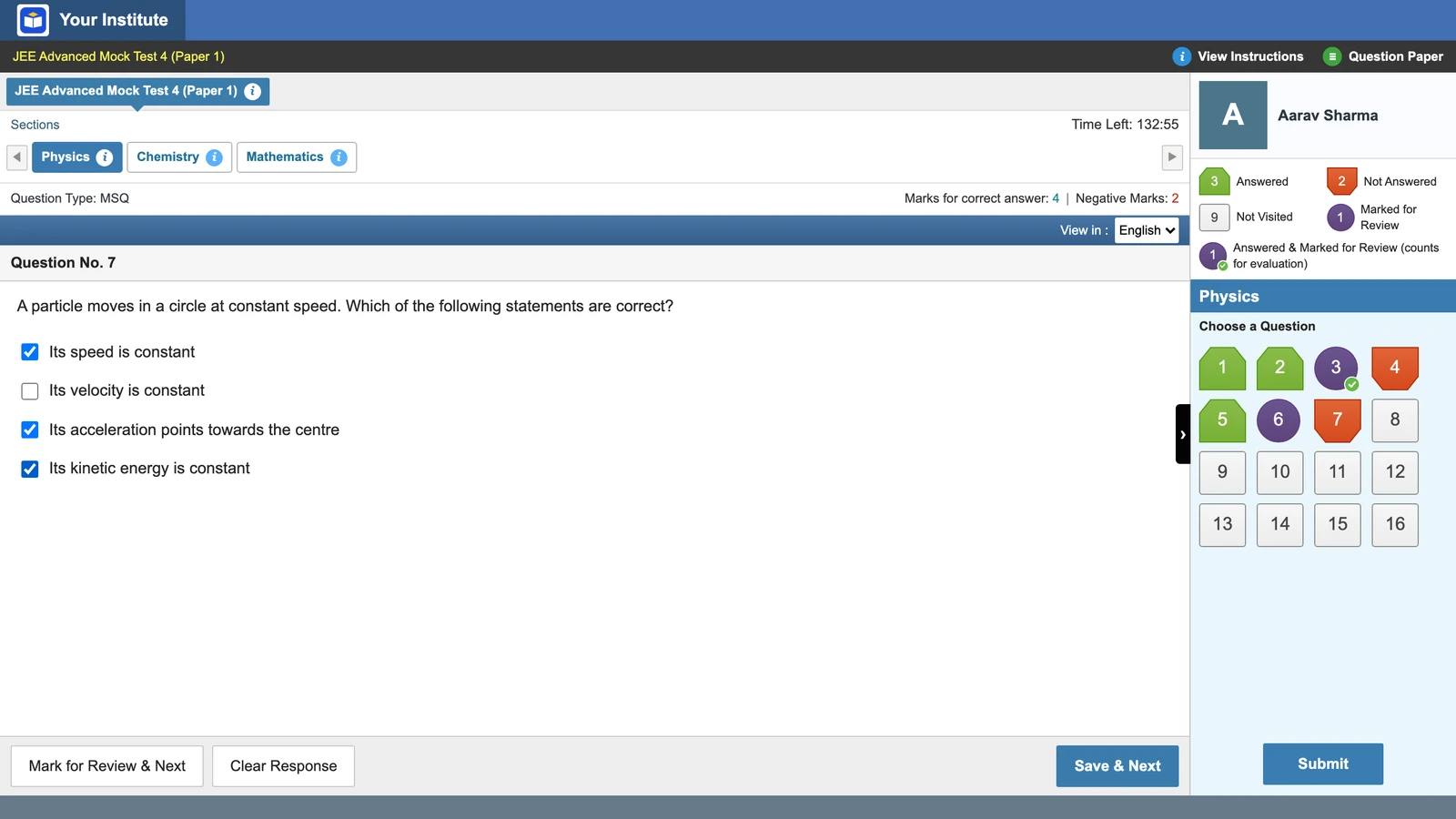
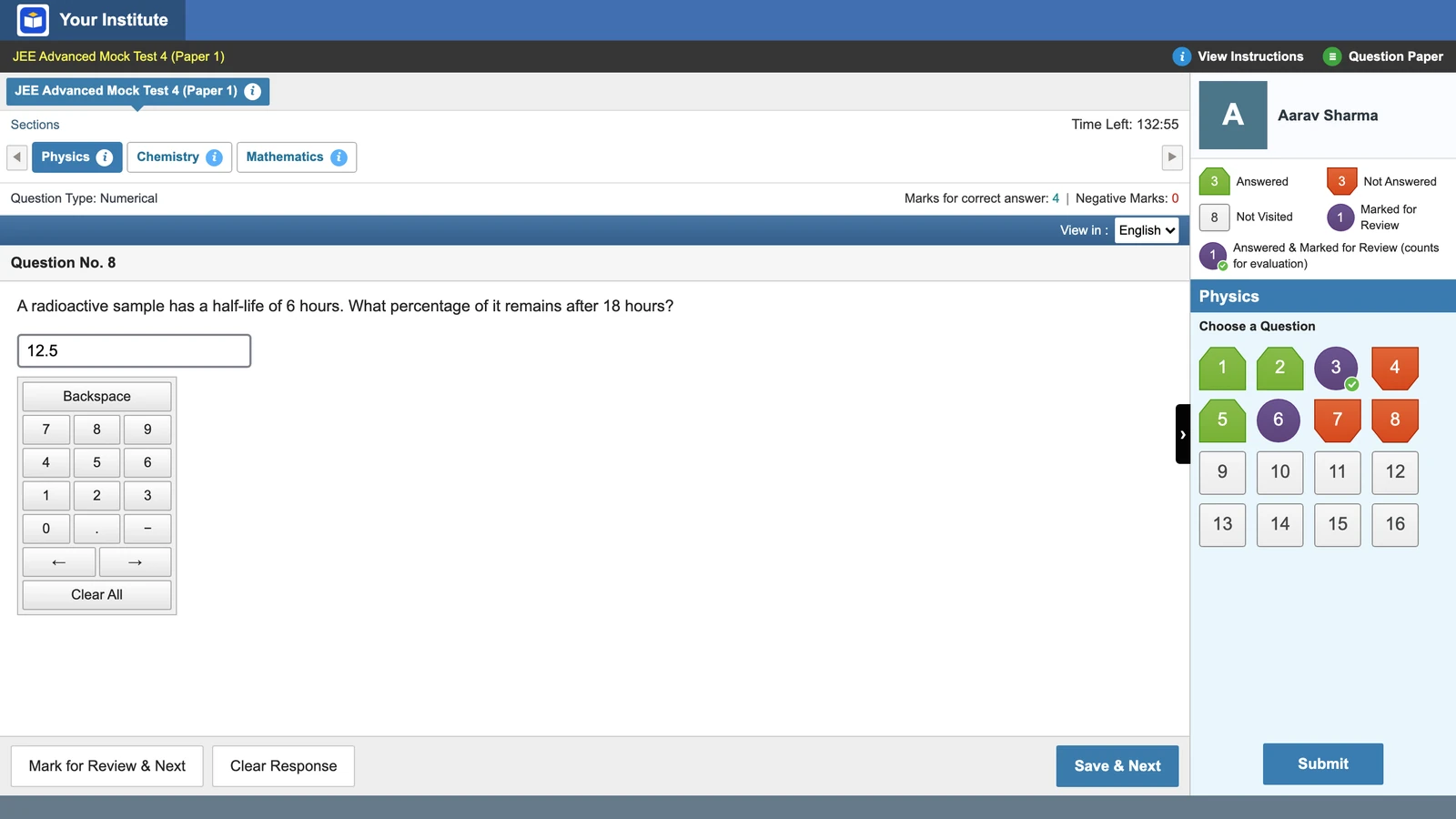
Strict saving is on by default, as in the real exam. A pick counts only after Save & Next or Mark for Review & Next. Jump away through the palette and the unsaved pick is lost. Numerical questions use an on-screen keypad with a decimal point and a minus key, and in strict mode the physical keyboard is blocked.
See one JEE Advanced paper set up end to end
We will build a short Paper 1-style test with you, from question types to the JEE Advanced-style screen.
Before you publish
A seven-point check for every mock
- 1Question counts and marks per section match the latest official mock, not an old table.
- 2Every multiple-correct key lists all the correct options, and at least one question has a single correct option.
- 3Numerical keys have two decimals. Where truncating and rounding give different answers, tell students which one to use.
- 4Negative numerical answers are allowed where the physics says so.
- 5The marks row on each question shows the right full and negative marks.
- 6The exam interface is set to JEE Advanced style, and strict saving is on.
- 7One teacher has taken the whole paper once, on a laptop, before students see it.
After the first mock, open the report. It separates correct, partially correct, incorrect and skipped answers. Students who ticked an extra wrong option show up as incorrect on multiple-correct questions, so check those questions first. More on that in question bank to rank report. To fill the bank faster, see the AI question generator for JEE and NEET.
What it does not do yet
Partial marks on multiple-correct questions are given in proportion to the correct options picked. Vacademy does not yet apply JEE Advanced’s exact +3/+2/+1 rule, so a mock score can differ from the real rule on those questions.
There is no one-click JEE Advanced pattern. Your team sets up the sections, counts and marks by hand for each paper. When the pattern changes, you change it.
The real exam also lets students switch each question between English and Hindi. Vacademy’s screen does not have that switch today.
For when to run sectional tests and when to run the full paper, see topic-wise vs full-syllabus mock tests.
Questions JEE teachers ask
What is the JEE Advanced paper pattern for 2027?
It is not published yet. The 2027 exam is on 23 May 2027, organized by IIT Delhi. The latest official pattern is the 2026 mock: Paper 1 has four sections per subject and Paper 2 has three, with 180 marks in each paper.
How many questions are in each JEE Advanced paper?
In the 2025 papers and the 2026 official mocks, 16 per subject, so 48 per paper. The 2024 papers had 17 per subject. Count again when the 2027 brochure and mocks are out.
How does partial marking work for JEE Advanced multiple-correct questions?
In 2025 and the 2026 mocks: +4 for all correct options, +3, +2 or +1 for picking only some correct options, 0 if left blank, and −2 if any wrong option is picked. Exam-day reports say the live 2026 papers used −1 instead. The exact rule is printed at the top of each section.
Are JEE Advanced numerical answers integers or decimals?
Since 2025 they are numerical values, truncated or rounded to two decimal places. In 2024 the same section asked for a non-negative integer. Give answer keys two decimals, and where truncating and rounding differ, tell students which one to use.
Can Vacademy set up the JEE Advanced pattern automatically?
Not yet. You create the sections, question types and marks by hand. Then pick the JEE Advanced-style exam interface for the test, and students see a screen laid out like the real computer-based exam.
Does Vacademy show questions in Hindi on the JEE Advanced-style screen?
Not yet. The real exam lets students switch each question between English and Hindi. Vacademy does not have that switch today, so plan bilingual batches with that in mind.
JEE (Advanced) is conducted by the Indian Institutes of Technology. Vacademy is not affiliated with the IITs or any exam body. “JEE Advanced style” describes the screen layout and behavior only. Pattern details are from the official papers and mocks, read on 13 November 2026.
Run your JEE Advanced mocks on Vacademy
Your questions, your sections and marks, on a screen your students will recognize in May.