Key takeaways
- RRB JE deducts 1/3 of a mark for every wrong answer in CBT 1 and CBT 2 (CEN 04/2026, paras 13.1 and 13.2). Three wrong answers cancel one right one.
- A blind guess among four options is worth zero on average. Ruling out one option makes it worth about +0.11; ruling out two, about +0.33.
- The minimums are 40% (UR, EWS), 30% (OBC, SC) and 25% (ST) (CEN 04/2026). They are floors for eligibility, not cut-offs.
- Read accuracy before the score. Vacademy's report gives correct, incorrect and skipped counts, the wrong options students chose, and time per question.
A Sunday mock in a railway-exam batch in Prayagraj. Student A finished all but eight questions and walked out sure of a good score. Student B left 32 blank. B scored nearly 11 marks more.
Students hear “avoid guessing” so often that the words stop meaning anything. What changes behavior is the arithmetic, shown on their own result.
The arithmetic: +1 and −1/3
In the CEN 04/2026 notice (paras 13.1 and 13.2), each question carries one mark, and “marks shall be deducted for each wrong answer @ 1/3 of the marks allotted for each question”, in CBT 1 and CBT 2 alike. A blank costs nothing.
Worked example, CBT 1 (100 questions)
More attempts, fewer marks
Student A
Attempted: 92
Right: 56 · Wrong: 36
Net: 56 − 12 = 44
Student B
Attempted: 68
Right: 58 · Wrong: 10
Net: 58 − 3.33 = 54.67
A blind guess among four options wins 1 mark a quarter of the time and loses 1/3 the rest. On average: zero. Rule out one option and that changes:
What one guess is worth, on average
Rule something out before you guess
A blind guess. Wins and losses cancel out on average.
One option ruled out.
Two options ruled out.
Take the last 20 questions, rushed. At 40% accuracy they add about 4 marks (8 right, 12 wrong). At 30%, just over 1. A lot of risk for very little.
Qualifying marks by category
CEN 04/2026, paras 13.1 and 13.2
Minimum marks for eligibility
| Category | Minimum | CBT 1 | CBT 2 |
|---|---|---|---|
| UR and EWS | 40% | 40 of 100 | 60 of 150 |
| OBC (NCL) and SC | 30% | 30 of 100 | 45 of 150 |
| ST | 25% | 25 of 100 | 37.5 of 150 |
These are floors, not targets. RRB calls about 15 candidates per vacancy to CBT 2 on normalized CBT 1 marks (and can change that number), so the real line is set by the competition. Look again at Student A: 44 clears the UR floor and is still a weak score.
Three student types you will see in mock results
The gambler
Attempts 90+, accuracy around 60%
High effort, low marks. Teach the 'rule out one first' rule and show the marks lost to wrong answers on every report.
The over-careful one
Attempts 50, accuracy above 90%
Safe but short. Check time per question: they often know more than they attempt, and run out of time on easy ones.
The steady one
Attempts about 75, accuracy around 85%
The target shape. Push attempts up slowly, one section at a time, while accuracy holds.
The numbers are examples; set your own lines. Sort students by the shape of their result, because the same score of 50 needs a different fix in each group.
What to read in a Vacademy report
Vacademy makes a report as soon as a student submits, for one student or the whole batch. Four parts do most of the work:
After each RRB JE mock
Four things to read before the score
It also shows each student’s strong and weak topics, and compares results with the batch average. Distractor analysis is the part teachers skip most. If 40 of 60 students pick the same wrong option, that is not guessing. Something was learned wrongly, and one class can fix it. More in from marks to meaning and finding learning gaps earlier.
Want to see this report on one of your own RRB JE papers? Send us a past paper and we will run it as a mock for a demo batch.
Mocks on the Railway JE (RRB) style screen
Guessing shows up most in the last minutes. In the official RRB JE mocks, Submit never opens before time is up, so spare minutes go to marked questions or to guesses.
On Vacademy, pick the Railway JE (RRB) style exam interface. With strict saving (the default), an answer counts only after Save & Next or Mark for Review & Next, and Submit stays locked until time is up. The marks row keeps the cost of a wrong answer in view.
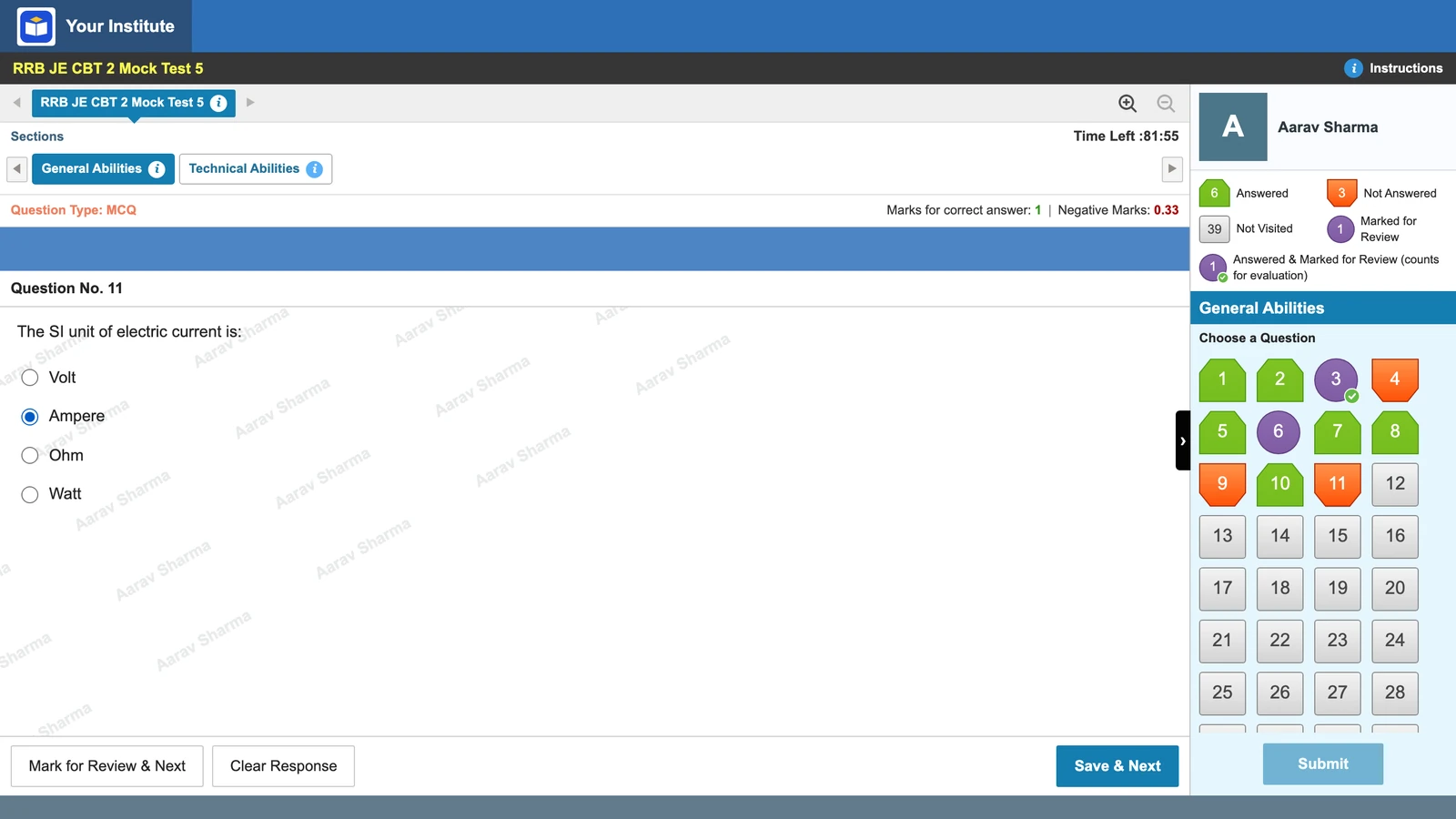
Run it as a mock test (the 90 or 120 minutes lock once the student starts) or as an examination with a fixed window for the whole batch.
Answered & Marked for Review counts for evaluation, as on the exam screen. Teach students that a marked guess is still a guess.
For the CBT 2 screen and pattern, see our RRB JE CBT 2 guide. For using reports to plan teaching, see AI assessments and teaching decisions.
Want your batch to practice the last minutes with Submit locked? We will set up a Railway JE (RRB) style mock for a demo batch.
A four-week accuracy plan
- Week 1One full mock as a baseline. Work out each student's accuracy, overall and by subject. Put each student in one of the three groups.
- Week 2Short subject tests with one rule: answer only if you can rule out at least one option. Go through the distractor analysis in class.
- Week 3A full mock on the Railway JE (RRB) style screen with strict saving. Compare accuracy and wrong answers with week 1.
- Week 4Two full mocks. Each student leaves with a written personal rule, such as 'skip anything I cannot narrow to three options'.
One honest limit: the guessing numbers are averages. On one paper luck can go either way, and RRB normalizes marks across shifts. The habit transfers, not the number.
Self-check: does your batch know what guessing costs?
- Mock results show a score, but not the marks lost to wrong answers.
- No one in the batch can say their own accuracy.
- You have never looked at which wrong option a batch picked most.
- Students can submit early, so the last minutes are never practiced.
Questions institutes ask
How much negative marking is there in RRB JE?
One third of the marks of the question for every wrong answer, in both CBT 1 and CBT 2. Each question carries 1 mark, so a wrong answer costs 1/3 of a mark and three wrong answers cancel one right answer. A skipped question costs nothing.
Is guessing worth it in RRB JE?
A blind guess among four options gains nothing on average: 1/4 of a mark won minus 3/4 × 1/3 lost is zero. After ruling out one option, a guess is worth about +0.11 of a mark on average; after ruling out two, about +0.33. So coach students to guess only after they can rule something out.
What are the RRB JE qualifying marks for each category?
The CEN 04/2026 notice sets minimum percentages of 40% for UR and EWS, 30% for OBC (NCL) and SC, and 25% for ST, for both CBT 1 and CBT 2. PwBD candidates may get up to 2 marks of relaxation if there is a shortage. These are minimums for eligibility, not cut-offs.
How do I calculate a student's net score in an RRB JE mock?
Net score = correct answers − (wrong answers ÷ 3). For example, 58 right and 10 wrong gives 58 − 3.33 = 54.67 out of 100. The Vacademy report gives you the correct, incorrect and skipped counts for each student.
What should teachers look at after an RRB JE mock test?
Accuracy (right answers out of those attempted) before the score, then which wrong options students chose most, time per question, and weak topics. In Vacademy these come from the answer breakdown, distractor analysis, time per question and strong and weak areas in each report.
Try Vacademy for your RRB JE mocks
Railway JE (RRB) style mock tests with your logo, and a report that shows right, wrong and skipped for every student.