A student in Kota opens Google and types “best NEET coaching near me”. Two years ago they would have seen ten blue links and opened four of them. Today the first thing on screen is an AI-written answer that already names a few institutes, explains what to look for in a good batch, and quietly settles the question. The student may never click a single website.
That is the shift, and it is easy to miss because nothing looks broken. Your website is still live. Your rankings may even be fine. But the moment of decision has moved from your website to a summary written about you by a machine — and most institutes are still optimising for the older internet, where being on page one was the whole game.
This post explains what actually changed, why education is affected more than almost any other industry, what an AI-search-ready academy looks like in practice, and a simple seven-step checklist you can start this week.
Ten links became one answer.
The shift in student discovery from 2023 to 2026
Choosing a NEET coaching institute
Compare batch size, faculty experience, fee structure and last year's verified results. Institutes that publish outcome data and clear course pages are the easiest to verify.
Sources quoted:
What Exactly Changed in Google Search
Google now does something it never used to do: it reads several sources and writes the answer itself. That is what AI Overviews and AI Mode are. Instead of handing the student a list and letting them figure it out, Google composes a short explanation and shows a handful of supporting links beside it.
It is worth being calm and accurate here, because there is a lot of noise in the market. Google's own guidance in AI features and your website says there is no secret setting and no separate “AI SEO” trick — pages become eligible through normal indexing and normal good practice. What changes is not the rules, it is the reward. Clear, well-organised, genuinely useful pages get quoted. Vague brochure pages get skipped.
Google says the same thing in different words in its guidance on creating helpful, people-first content: write for the person asking, show who you are and how you know what you know. That has always been good advice. It is now the difference between being summarised and being ignored. And this is not only a Google problem — students also ask ChatGPT, Perplexity and YouTube's summaries the same questions, and those systems read the web the same way.
Old internet
Student types a question, gets ten links, opens three or four websites.
Now
Student types a question, reads one AI-written answer, and opens a site only if something in that answer earns the click.
Old internet
Winning meant ranking number one for a keyword.
Now
Winning also means being one of the sources the AI answer is built from and named after.
Old internet
Search happened on Google.
Now
Search happens on Google, ChatGPT, Perplexity, YouTube and Instagram — often all four before a parent calls you.
Where Students Actually Search Now
Multiple paths, one ultimate destination
Google AI Overviews
Verified local suggestions
ChatGPT
Conversational analysis
Perplexity
Direct search + citations
YouTube summaries
Video transcripts & channels
Your Academy
Consistently syncs details to all 4 engines
Why This Hits Education Harder Than Most Industries
Nobody researches a toothpaste for three weeks. Families research a coaching institute for months. They compare fee structures, ask about faculty, hunt for last year's results, read reviews and ask friends. Every one of those steps is a question — and questions are exactly what AI answers are built to handle.
The queries families use are also the easiest kind for an AI system to answer directly: “best coaching for CAT in Indore”, “is a dropper batch worth it”, “IELTS coaching fees near me”. These are local, comparative and intent-heavy. If your website does not state your fee, your batch structure or your results anywhere in plain text, you simply cannot appear in the answer — even if you are the best institute in that city.
That is the quiet risk. Teaching quality is invisible to a search system. What is visible is documentation. An institute with average teaching and an excellent, honest, up-to-date web presence will be recommended over a great institute with a five-page brochure site. It is not fair, but it is fixable — and it is really a trust problem before it is a technical one, which we have written about in the digital trust factor.
There is a second effect worth planning for. When AI answers part of the research, the people who do reach your enquiry form are further along and better informed. Fewer enquiries, warmer enquiries — which puts more weight on how you handle each one. If your follow-up is slow or scattered, this is the year it starts to hurt, and a tighter enquiry-to-enrolment funnel is the fix.
The Anatomy of an AI-Search-Ready Academy
Four things separate an academy that gets quoted from one that gets skipped. None of them require a technical team.
The Pillars Holding Up Your Visibility
If one collapses, search engines lose confidence
Clear, factual pages
Detailed course modules, fees, batches.
Consistent details everywhere
Same details on web, GMB, and social.
Content stays current
Regular updates to dates and proofs.
More than text
Videos, community, active mentor Q&As.
Clear, factual pages
One page per course with the fee, duration, batch timing, syllabus, eligibility and outcome written in plain sentences. AI systems can only repeat facts they can find and read.
Consistent details everywhere
Same institute name, same address, same phone number and same course names on your website, Google Business Profile, social pages and directories. Mismatched details reduce confidence in your data.
Content that stays current
New batch dates, this year's results, fresh testimonials, updated fee structures. A page last touched in 2023 tells every system that your information may be stale.
More than text
Short faculty videos, recorded doubt sessions, student stories and an active community. These build the topical depth that both students and AI systems read as real expertise.
A word on structured data
Structured data is a small block of code that labels your content so a machine does not have to guess. It says: this is the course name, this is the provider, this is the duration. The vocabulary is public — see the Course type on Schema.org — and Google documents exactly what it expects in its guide to Course structured data.
One honest correction to advice you will still see repeated everywhere: FAQ rich results were retired from Google Search in May 2026, so adding FAQ markup will no longer win you that expanded listing. Writing genuine questions and answers on the page is still very much worth doing — it is some of the most quotable content you can publish — just do it for the reader and the answer engines, not for a rich snippet that no longer exists.
If your course pages already live in a platform that outputs proper titles, descriptions and course fields, most of this is handled for you. That is one practical advantage of keeping your catalogue in a structured system like Vacademy's course authoring rather than in hand-built pages that drift out of date.
Anatomy of an AI Answer
How search engines find, read, and structure your outcomes
The System Reads
matches, extracts, verifies
Fees for a NEET dropper batch
Typically ₹1.2–1.8 L per year including test series, with batch sizes of 40–120 students.
The real bottleneck is not knowledge. It is time.
Most institute owners already know they should publish results, update batch pages and record short explainers. It does not happen because faculty are teaching and the website is somebody's weekend job.
The institutes that stay visible are not the ones with the biggest marketing budget. They are the ones whose day-to-day platform produces publishable, structured material as a by-product of running classes.
Where Vacademy Fits In
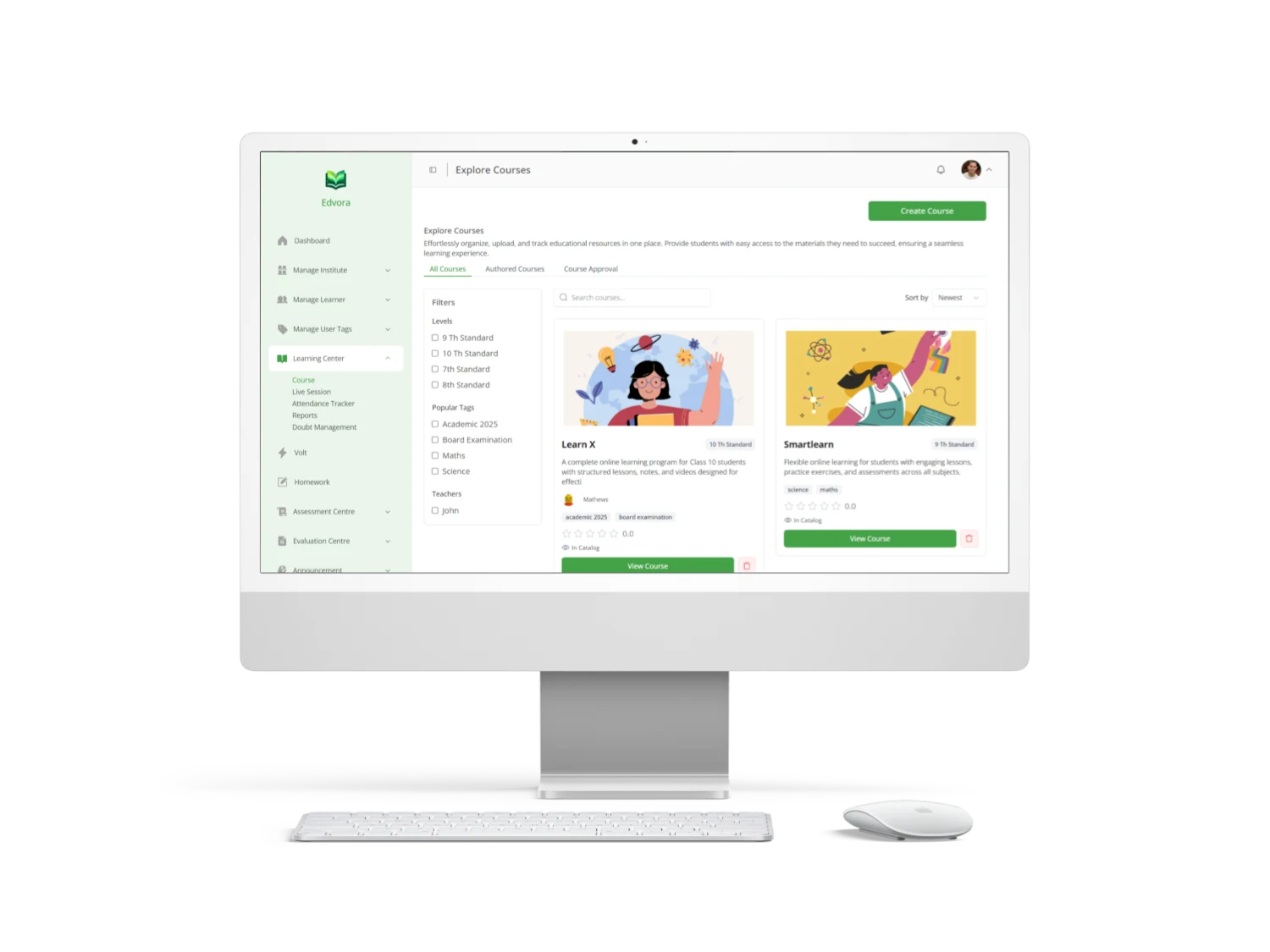
Vacademy was not built as an SEO tool, and we are not going to pretend it is one. It was built as a single place to run courses, mentorship, admissions and analytics. But a useful side effect of running your academy on a structured platform is that your public presence becomes structured too.
- Your course catalogue, mentor profiles and learner outcomes live as real, consistent data — so your branded website always reflects what you are actually teaching this term, not last year.
- AI-assisted content and doubt-support tools help faculty produce explainers, question sets and session recaps quickly, with real mentors still at the centre of the learning.
- Mobile-first, video-friendly delivery means the material students consume is the same material that builds your public depth.
- Warmer, better-informed enquiries land in one place with the admissions CRM, and analytics and reports show which programmes are actually producing the outcomes worth publishing.
The result is not a ranking trick. It is an academy that is genuinely well documented — which is the only thing any answer engine can reward.
A Seven-Step Checklist for Institutes
Nothing here needs a developer or a big budget. Do them in order and most institutes see a difference within a quarter.
Is your academy AI-search ready?
Review the checklist to audit your readiness
Audit what students find
Search your courses + city. Locate missing, inaccurate, or old data.
One honest page per course
Specify fees, durations, syllabus, eligibility, and faculty transparently.
Add course structured data
Inject schema tags to ensure systems process fields accurately.
Answer real questions
Publish QA directly addressing parents' doubts about batches.
Publish outcomes monthly
Maintain proof of success. Recency earns priority in AI indexes.
Google Business Profile
Verify your location, reviews, correct operating hours, and photos.
Turn on video & community
Host mentor QA and video explainers to demonstrate depth.
Audit what a student can actually find
Search your institute name, then your main course plus your city. Note what appears, what is missing and what is wrong. That gap list is your work plan.
Give every course its own honest page
Fee, duration, batch size, syllabus, faculty, eligibility, outcome. No page should force a student to call you just to learn the basics.
Add structured data for courses and your organisation
Mark up course pages so machines read your fields as fields, not as decoration. Validate the markup before you assume it works.
Answer real questions in real words
Write the questions parents actually ask — is this batch worth the fee, what is the success rate, what happens if my child misses a class — and answer them directly on the page.
Publish one outcome story every month
A result, a placement, a student journey. Recency and proof are the two things a thin website never has.
Claim and update your Google Business Profile
Correct hours, correct address, real photos, recent reviews. For local searches this is often the single highest-return hour of work.
Turn on video and community
A weekly mentor Q&A and short subject videos give you fresh, quotable material without hiring a content team.
For step six, follow Google's guidelines for representing your business exactly — your listed name should match your real signboard, not a keyword-stuffed version of it. And if you are weighing what a platform switch would cost against doing all of this by hand, our pricing page is deliberately plain about it.
See How Discoverable Your Academy Really Is
Book a free discovery-readiness audit. We search for your institute the way a student would, show you what comes back, and point out the gaps worth fixing first.
Related reading
Frequently Asked Questions
What is AI search optimization for education institutes?
It is the work of making your institute's information clear, factual and current enough that AI answer systems can read it and repeat it accurately. In practice it means proper course pages, consistent business details, structured data and regularly published proof — not a separate set of tricks.
Do AI Overviews mean my website traffic will drop?
Often yes, in raw numbers. But the visitors who do arrive are further along in their decision because the AI has already handled the basic research. Judge the change by enquiries and enrolments, not by pageviews alone.
Is there a special setting to appear in Google's AI Overviews?
No. Google states there are no additional requirements or special optimizations — pages become eligible through normal indexing. What helps is clear structure, genuine expertise and content that directly answers the question being asked.
Should I still add FAQ schema to my pages?
FAQ rich results were retired from Google Search in May 2026, so the markup no longer earns you an expanded listing. Keep writing real questions and answers on your pages though — that content is easy for answer engines to quote and genuinely useful to parents.
How often should a coaching institute update its website?
At minimum, once a month. New batch dates, a recent result, a student story, an updated fee structure. Recency is one of the few signals a small institute can compete on against a national brand.
Does this matter for a small institute with one branch?
It matters more. Local, intent-heavy searches are exactly what AI answers handle best, and a single-branch institute with an accurate Google Business Profile and honest course pages can appear alongside far larger names.
Conclusion: Optimise for Trust, Not Just Rankings
It is tempting to read all of this as a new technical race — new markup, new tricks, new jargon like Answer Engine Optimization. It is simpler than that. Every one of these systems is trying to do the same thing: find a reliable source of truth about your academy and repeat it.
So the work is not really about search at all. It is about being the clearest, most current, most honest source of information about your own institute — clearer than a directory, more current than a review site, more honest than a competitor's brochure. Do that and you will be quoted by whatever comes after AI Overviews too. Skip it and no amount of keyword work will save you.
The five things worth remembering
- Students now get an answer before they get links — the decision moves off your website.
- Teaching quality is invisible to a search system. Documentation is what it can see.
- There is no secret AI-SEO setting. Clear course pages, consistent details and fresh proof are the whole game.
- Fewer but warmer enquiries means your follow-up matters more than it used to.
- Write for the parent asking the question, and the answer engines follow.
If you want to see where your academy stands today, the quickest start is the structured presence you already have — and the gaps a student would hit before they ever reach your enquiry form.