Key takeaways
- In each SAT section, Module 1 mixes easy, medium and hard questions. Bluebook then gives a harder or an easier Module 2. About half of students go each way.
- A fixed mock built by your institute cannot give a true SAT score. Use College Board's free Bluebook practice tests for scores.
- Use your own tests to teach: one Module 1 set, then a harder and an easier Module 2 set that your teacher assigns by hand.
Picture an SAT teacher at an online institute in Bengaluru. She builds a 98-question paper, marks it, and turns the marks into a number between 400 and 1600 with a conversion table. A student we will call Riya is happy with her number. Two weeks later she takes a free practice test in Bluebook, College Board's test app, and gets a different one.
The teacher was not careless. Her paper simply cannot do what the SAT does: change the second module for each student, and weigh answers by how hard each question is.
So what should your own mocks do? Here is the honest answer, and a drill you can run next week.
How Module Routing Works
College Board calls this multistage adaptive testing. Its Assessment Framework explains it simply: same kind of first module for everyone, then one of two second modules.
Module 1 · everyone starts here
Half the section's questions
A broad mix of easy, medium and hard, from all four content areas
Harder Module 2
More hard questions, some easy and medium
about half of students
Easier Module 2
More easy questions, some medium and hard
about half of students
Section score, 200–800
from the scored questions in both modules
Two findings from College Board's own simulations are worth showing parents. Over 93% of simulated students were routed as expected, and where routing went wrong, it had no real effect on scores. And a student who misses Module 1 questions on purpose, hoping for the easier module, would likely score lower. The easier path caps how high a student can go.
Locked Modules, a Red Timer at Five Minutes, No Going Back
- Inside a module, students can move back and forth and mark questions for review. Once they move on, they cannot go back.
- The timer can be hidden until five minutes remain. Then an alert appears, the timer stays on screen, and the directions describe it turning red.
- There is a 10-minute break between the sections. An unscheduled break does not stop the clock.
One trap for teachers: Bluebook's practice tests let students move from one section to the next before time runs out. On test day they cannot. Ask students to use the full time in practice too.
Want a timed module drill whose clock locks once the student starts? We will set one up with you.
What a Fixed Mock Can and Cannot Tell You
The SAT is scored with item response theory. In College Board's words, two students with the same number of correct answers on different forms can still get different scores. Each module also hides two unscored trial questions. A conversion table from raw marks cannot copy any of this.
Your own mock can show
- Which skills and content areas are weak
- Pacing: does the student finish each module?
- Which wrong options students fall for
- Stamina, if you run modules back to back
It cannot show
- A true SAT score: the real one is scaled by question difficulty
- Which Module 2 the student would really get
- The exact Bluebook screen and tools
Pacing is the most useful thing your own tests can teach. College Board's own figures work out to about 1.2 minutes a question in Reading and Writing and 1.6 in Math. A student who spends four minutes on one Math question has used the time for two and a half.
Want to see a two-level module drill set up in Vacademy? We will build one with you.
Two-Level Module Drills: Build an Easier and a Harder Set, Assign Them Yourself
This is digital SAT adaptive test practice done by hand. It gives no score, but it teaches students what each path feels like.
- 1
Module 1 set
27 Reading and Writing questions in 32 minutes (or 22 Math in 35). Easy, medium and hard mixed, every content area.
- 2
Teacher reads the result
Same evening. A teaching choice, not a prediction: College Board does not publish its cut.
- 3
Harder or easier set
Send each student the link to one of two Module 2 sets. Both keep some questions of every level.
- 4
Review together
Look at marks by difficulty level, time per question and the wrong options chosen.
Vacademy has no adaptive tests, so your teacher does the routing. The rest is built in. A Mock assessment locks its clock once a student starts, so set it to 32 or 35 minutes. Share each Module 2 set's link only with the students who should take it, or keep students in batches by level. The report shows marks against difficulty level, time per question and the wrong options chosen. That is how learning gaps show up early.
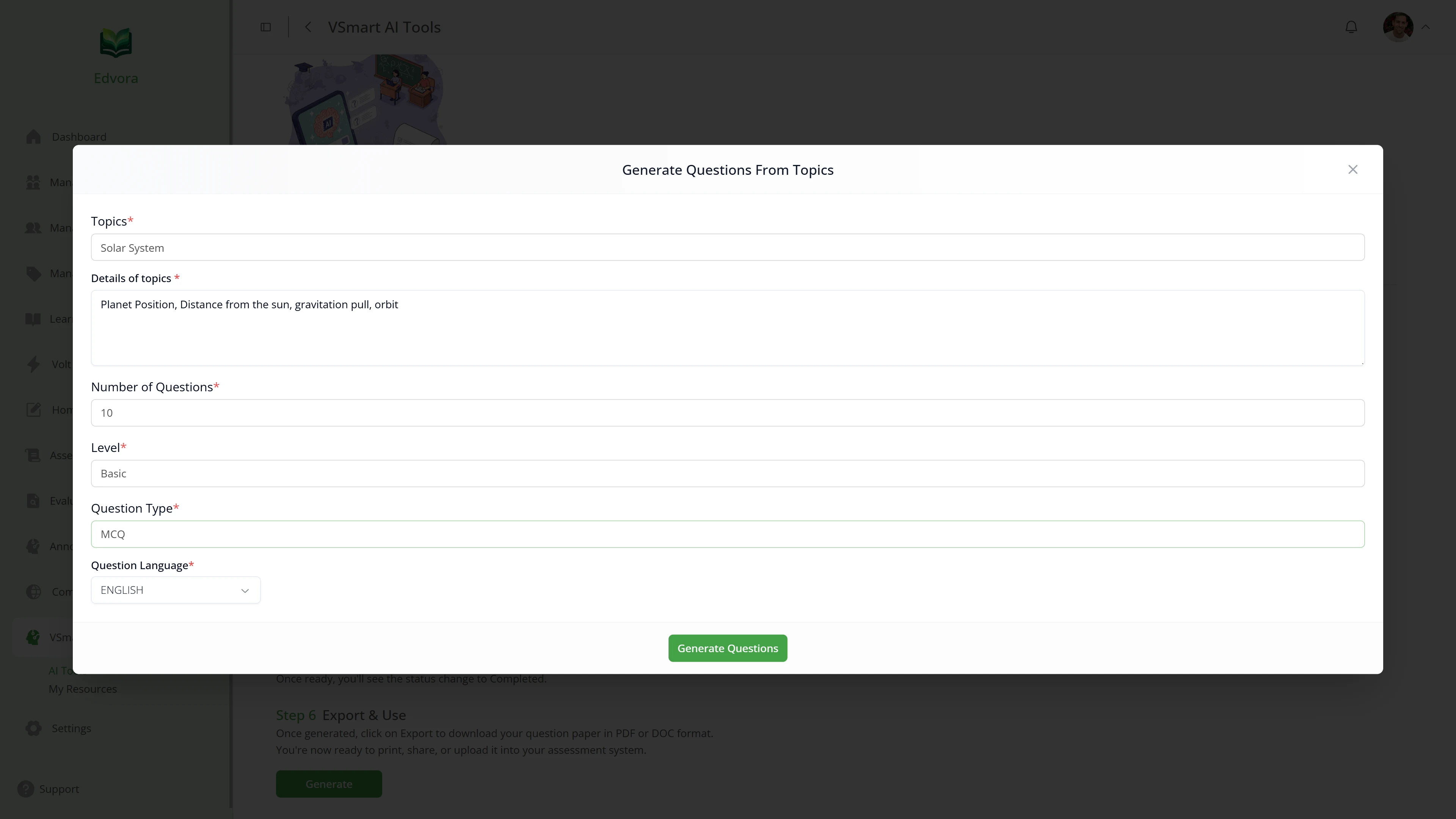
Three sets per drill is a lot of writing. Vacademy's AI tools draft questions on a topic at the level you choose, and your teacher edits each one. Do not copy College Board's questions. More practice ideas are in how AI can improve exam prep, and the course plan around these drills is in our guide to running SAT coaching from India.
Try Vacademy With One SAT Drill
Bring one topic. We will build a timed module set and its harder and easier follow-ups with you.
Frequently Asked Questions
How does the Digital SAT adaptive test work?
Each section starts with a module that mixes easy, medium and hard questions. Based on how the student does, Bluebook then gives one of two second modules: one harder on average, one easier on average.
Can an institute's own SAT mock test give an accurate score?
No. The SAT is scored with item response theory, so two students with the same number of correct answers can get different scores. For a score, use College Board's free practice tests in Bluebook.
Can students go back to Module 1 after starting Module 2?
No. Inside a module, students can jump between questions. After they leave a module, it is closed for good.
Should students miss questions on purpose to get the easier second module?
No. College Board's simulations found this would likely give a lower score, because doing badly in Module 1 sharply limits the highest score a student can reach.
What happens when five minutes are left in an SAT module?
Students get an alert, and the timer can no longer be hidden. College Board's directions describe the countdown turning red at that point.
Does Vacademy run adaptive SAT tests?
No. Vacademy has no adaptive tests. A teacher builds an easier and a harder second set and sends each one to the students who need it.
SAT, Bluebook and College Board are trademarks of College Board. Vacademy is not affiliated with or endorsed by College Board. SAT facts were read from College Board's pages and the Assessment Framework v4 on 13 November 2026.