Key takeaways
- The best AI tutor depends on who will use it. A free study mode is fine for one student who studies alone. An institute needs a tutor that teaches its own notes and tells the teachers how students are doing.
- Check five things: Does it use your notes? Does it ask questions? Does it speak Hindi? Does it report to teachers? Can teachers check it first?
- Tutezy by Vacademy turns your PDFs, videos and slides into live lessons on a whiteboard, in English or Hindi. It can teach with a personalized AI avatar of your own teacher, in that teacher's voice.
- AI tutors work best between classes. They help your teachers. They do not take their place.
It is 11 pm in a rented room in Kota. A NEET student has read the heat chapter twice. She still does not understand it. The next doubt class is on Saturday. Her teacher has 120 students and only one free hour.
AI tutoring is made for this gap between the class and the exam. In 2025, OpenAI and Google both added a “tutor mode” to their chatbots. Now there are many AI tutors to choose from. Most lists of the best AI tutoring platforms are written for students or parents. This one is written for the owner of an institute.
So we ask every platform one question. Can it teach your chapter, in the language your students understand, and tell your teachers who is stuck?
Please note: Tutezy is made by Vacademy, the company that writes this blog. We checked it with the same five questions as the others. Where another platform is better, we say so.
In short
An AI tutoring platform uses AI to teach one student at a time. It explains a topic, asks questions and checks the answers. Then it decides what to teach next, based on what the student got wrong. That is what makes it personalized.
Does AI Tutoring Actually Help Students Learn?
Yes, and there is now good proof. In 2023, Harvard University tested this in a large first-year physics class. Each student learned one topic from an AI tutor at home. They learned another topic in a good live class. Then they switched.
What the research says
A Harvard trial: AI tutor vs a strong live class
194
students, each tried both ways
2×+
more than double the learning with the AI tutor, for a typical student
49 min
time a typical student spent with the AI tutor. The class took 60 minutes.
Students learned more with the AI tutor, and in less time. But look at how it was done. The course's own teachers built the tutor. It taught the same way as the live class, and it had full step-by-step answers to every problem. It was not a student typing into a free chatbot.
This is the lesson for an institute. The good result came from how the tutor was built, not just from using AI. So choosing the right platform matters a lot.
What to Look For in an AI Tutoring Platform
Think of a batch of sixty students. In a one-hour class, maybe five of them ask a question. The other fifty-five go home with their doubts. A good AI tutor should help those fifty-five. Ask these five questions to find out if it can.
Checklist
5 questions to ask before you choose
1. Does it teach from your material?
Your modules, DPPs and recorded classes. Not random pages from the internet.
2. Does it ask, or only answer?
A good tutor checks if the student understood. A chatbot only waits for questions.
3. Can it teach in Hindi too?
Many students think in Hindi, even when the exam paper is in English.
4. Does it tell the teacher who is stuck?
Which topics the batch finds hard, and which student is weak in what.
5. Can teachers check it first?
Teachers should see and edit a lesson before students do.
Best AI Tutoring Platforms for Personalized Learning in 2026
Here are five platforms, checked with those five questions. The table gives a quick answer. Below it, each one is explained.
Quick comparison
Five AI tutoring platforms, side by side
Tutezy
by Vacademy · Institutes teaching their own course
ChatGPT Study Mode
by OpenAI · A student who studies alone
Gemini Guided Learning
by Google · Step-by-step help on any topic
NotebookLM
by Google · Revising from your own notes
Khanmigo
by Khan Academy · US families; teacher tools
1. Tutezy by Vacademy: best for institutes teaching their own course
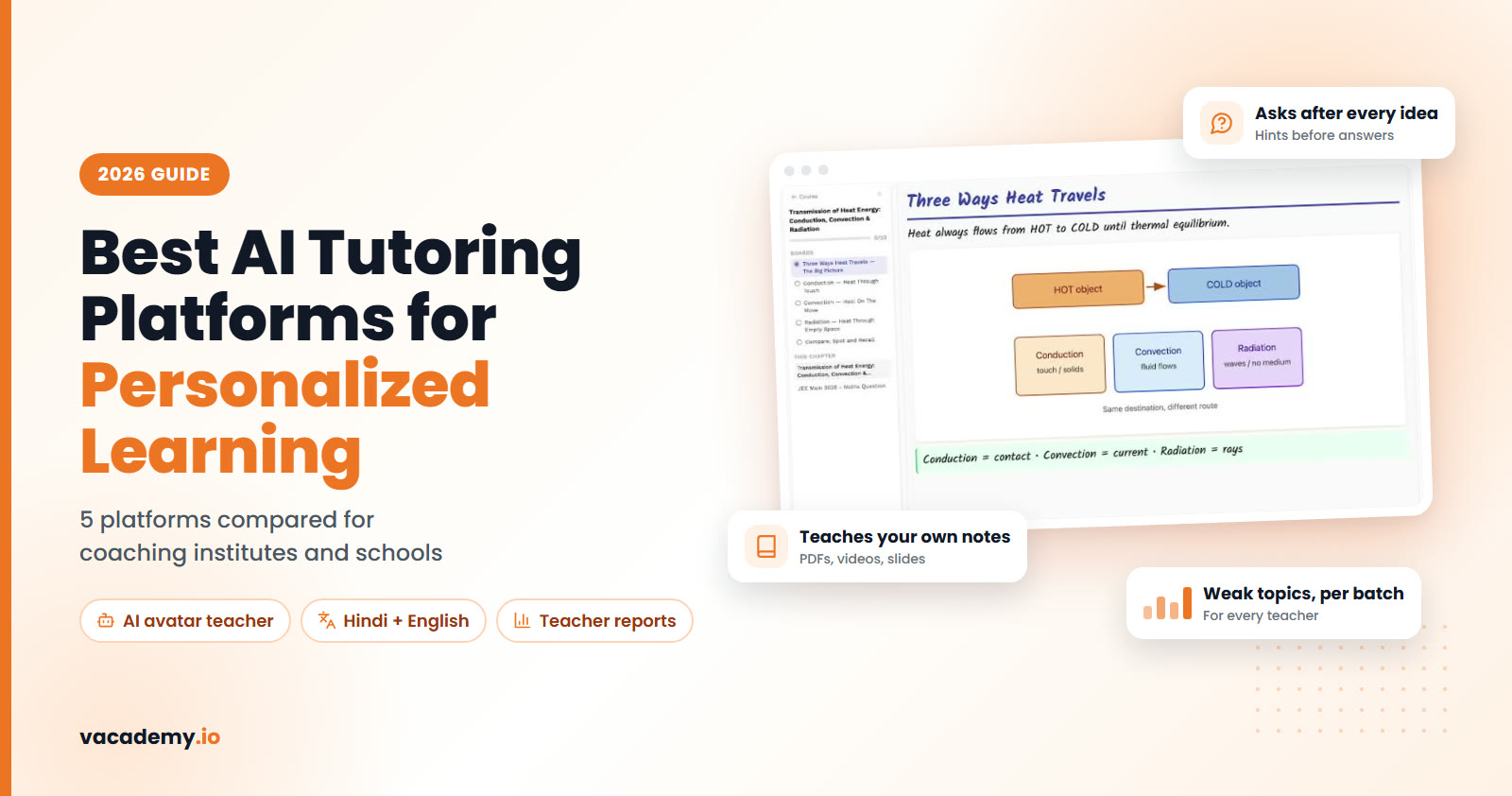
Tutezy takes the notes an institute already has and teaches them as a live, one-to-one lesson. It writes on a whiteboard, speaks in your teacher's voice, and asks a question after every idea. Of the five, it is the only one built around an institute's own notes. You can read more about it below.
Watch out for: for now it teaches only in English and Hindi. And a lesson is only as good as the notes you give it.
2. ChatGPT Study Mode: best free option for a student who studies alone
OpenAI added study mode to ChatGPT in July 2025. It is free. It does not give the answer straight away. It asks small questions that lead the student to the answer, and checks that they understand. For a hard-working student, it is a patient helper at any time of day.
Watch out for: the student can turn it off with one click and just get the answer. It only knows your syllabus if the student copies it in. And the institute sees nothing: no report, no list of weak topics.
3. Gemini Guided Learning: best for step-by-step help on any topic
Google launched Guided Learning in Gemini on 6 August 2025. It is free for everyone. It breaks a problem into small steps and explains the “how” and “why”. It can use pictures, diagrams and videos. It can also make study notes from files the student uploads.
Watch out for: the same problems as ChatGPT. The student decides whether to use it. It only knows the notes they upload. And the teacher gets no report.
4. NotebookLM: best for revising from your own notes
Google's NotebookLM answers only from the files you upload. It shows the exact line each answer came from. So it is much less likely to go outside your syllabus. It can also make quizzes, flashcards, study notes and short audio talks from your notes. Google says it does not use these files to train its AI.
Watch out for: it is more of a study notebook than a teacher. It does not teach a lesson in your teacher's voice. Reports for teachers are only in Google's paid plan for schools.
5. Khanmigo: best teaching method, but not for India yet
Khanmigo comes from Khan Academy, a non-profit. It does not give away answers. It makes the student think. Its tools for teachers (lesson plans, marking guides and quiz questions) are free in many countries.
Watch out for: the plan for students and parents is sold only in the US. It also teaches Khan Academy's own lessons, not your modules.
Want to see your own chapter taught as a one-to-one lesson? Bring one PDF to a 20-minute demo.
How Tutezy by Vacademy Supports AI-Powered Personalized Learning
Most AI tutors learn from the internet. Tutezy learns from your chapter. For an institute, this is important. Your teachers have spent years deciding how to explain each topic, which shortcut to teach and which mistakes to warn about. A tutor that does not know this is teaching a different course.
Turning existing educational content into interactive lessons
You upload what you already use: chapter PDFs (scanned ones too), recorded classes, slides and question banks. Tutezy reads them and plans a lesson for each slide. Each plan has board work, solved examples, diagrams, quick questions, hints and a short revision.
Then the teacher checks it. You can see every board before a student does, and change any part you do not like. You also choose the tutor's name, voice and speed, and how strict it should be: gentle, normal or strict.
How Tutezy works
From your chapter PDF to a one-to-one lesson
Step 1
Upload
PDFs (scanned ones too), recorded videos, slides and question banks
Step 2
Tutezy plans
Board work, examples, diagrams, quick questions, hints and a short revision
Step 3
Teacher checks
See every board first, change any part, pick the voice and speed
Step 4
Student learns
Live whiteboard, a question after each idea, answers by voice or typing
Step 5
Teacher sees
Hard topics for the batch, each student's weak topics, minutes taught
A personalized AI avatar for teaching
Students learn better from a teacher they know. So Tutezy can teach with an AI avatar of your own teacher. It is made from just one photo of the teacher. The avatar moves and speaks on screen, and its lips match the words.
The voice can be your teacher's too. Tutezy copies it from a short recording, about 15 seconds long. So a student in Kota hears the same teacher at 11 pm that they heard in class that morning.
AI avatar
Your teacher, as an AI avatar, in 3 steps
Step 1
Add one photo
The teacher uploads one photo of themselves.
Step 2
Record the voice
A short recording, about 15 seconds, for the voice.
Step 3
Start teaching
The avatar teaches every lesson, in English or Hindi.
The teacher must agree first. The avatar and voice stay private to your institute, and you can turn off or delete the voice at any time. If you do not want your own avatar, ready-made avatars are free to use.
Supporting individualized learning experiences
In the lesson, Tutezy writes on the board line by line, like a teacher. After each idea, it asks a question and waits. If the student is quiet for too long, it reminds them. The student can answer by speaking or by typing.
If the answer is wrong, the student first gets a hint, not the answer. Tutezy remembers which topics each student gets wrong. It goes over those again, and starts the next lesson with a short revision. At the end, the student keeps the notes and a summary.
A student can switch between English and Hindi in the middle of a lesson. There are four speeds, from slow to fast. So the student in Kota at 11 pm can ask “explain it again” five times. Nobody gets tired of her.
Helping coaching institutes and EdTech businesses scale
Here is the simple maths. A teacher has 120 students. To give each one 20 minutes alone, the teacher needs 40 hours. That is a full working week, with no classes taught. It never happens, so most students never get that time.
Tutezy gives every student that time, between classes. For coaching institutes, it works for NEET, JEE, UPSC, banking, SSC, CA and CUET preparation. It can:
- teach chapter lessons from your modules and DPPs
- solve doubts, and note the topic for the teachers
- go through each student's wrong answers after a test
- practise previous-year questions
- do quick revision before an exam
You pay only for the minutes students use. You buy credits in advance, and there is no fee per student. A quiet month costs less than a busy one.
Integrating AI tutoring into an existing learning strategy
Students do not need a new app. Tutezy works inside the Vacademy student app, on web, Android and iOS. The admin turns on Tutor Mode in settings. Then each chapter shows a “Learn with the teacher” button.
This matters, because the tutor sits next to everything else the institute uses: live classes, online tests, recorded lessons and doubt support. Tutezy shows how well each student knows each topic, and how many minutes they learned. Rank and percentile come from Vacademy's test reports. Together, they show the teacher everything.
Blended learning
One week in a batch that uses an AI tutor
Monday
TeacherTeacher: Live class on the new chapter
Mon–Thu evenings
AI tutorAI tutor: Each student revises the chapter one-to-one, in English or Hindi
Friday
TeacherTeacher: Reads the batch report and plans the doubt class on the hardest topics
Sunday
Vacademy testVacademy test: Chapter test, checked automatically, with rank and weak topics
Sunday night
AI tutorAI tutor: Goes through each student's own wrong answers with them
The teacher still teaches every chapter. The AI tutor does the extra work: explaining again, late-night revision and one-to-one help that no teacher has time for.
Challenges and Limitations of AI Tutoring
AI tutors are useful, but they are not magic. The institutes that do well with them plan for the problems. Here are the four biggest ones, and what to do about each.
Wrong answers that sound right
AI can explain a wrong method and sound very sure. A student who is already confused will not notice.
What to do: Choose a tutor that teaches from your notes. Let a teacher check the lessons first, and read a few lesson records every week.
It cannot understand feelings
An AI will not notice that a topper has gone quiet for two weeks, or that a student is scared of the next mock test.
What to do: Keep a teacher or mentor in touch with every student. When the AI report shows a problem, call the student.
Student data and privacy
Most coaching students are under 18. India's new data rules (DPDP Rules, November 2025) say an app must get a parent's permission before it uses a child's data. This starts in May 2027.
What to do: Ask every company four questions. Do you train your AI on our notes? Who can see student data? Can we download it and delete it? Where do you record parent permission?
Nobody is checking
If nobody looks after the tool, lessons get old and nobody reads the reports.
What to do: Ask one teacher per subject to spend 20 minutes a week on the batch report. Fix the lesson where most students got stuck.
On privacy, the DPDP Rules make the institute responsible for its students' data, even when another company stores it. Tutezy's security page says it does not use your notes to train AI. Only your own admins can see student data. A teacher's voice is copied only after that teacher gives permission. Every lesson is saved, so you can read exactly what a student was told.
AI tutors should support teachers, not replace them
Many owners worry: will AI replace my teachers? No. Even Tutezy's own website says human tutors are better at judging a student and keeping them motivated. AI only takes away the repeat work: the same explanation for the tenth time, the 11 pm doubt, going through one student's wrong answers. So teachers get more time for the work only they can do.
Future Trends in AI Tutoring for 2026 and Beyond
Some of these have already started. Expect them to be normal in the next two or three years.
Tutors that change with the student
The tutor remembers which topic each student keeps getting wrong, and comes back to it.
Speaking instead of typing
Students answer out loud. This helps younger students and language practice.
AI-made quizzes
A quick question after every idea, and practice sets made from the teacher's own chapter.
Hindi and other Indian languages
Lessons in the language a student thinks in, with science words kept in English.
Revision from each student's mistakes
Each student gets a revision list made from their own wrong answers.
Tutors inside the learning app
The tutor, the tests and the live classes in one place, so teachers see everything together.
To learn more, read how AI is changing the future of online learning and our guide to AI in personalized learning.
Frequently Asked Questions
What is the best AI tutoring platform in 2026?
There is no one best platform. It depends on the student, the subject, the budget and what you need. For one student who studies alone, the free study modes in ChatGPT or Gemini work well. For a coaching institute that wants its own notes taught in Hindi and English, with reports for teachers, a platform made for institutes is better, such as Tutezy by Vacademy.
Can AI tutoring platforms provide personalized learning?
Some can. A good AI tutor asks a question after each idea and checks the answer. It gives a hint before the solution. It also goes back to the topics a student keeps getting wrong. A simple chatbot only answers what it is asked, so the student has to know what to ask.
Are AI tutors better than human tutors?
No. They are good at different things. An AI tutor is patient, works at midnight, and can explain the same idea five times. A human tutor can see when a student is worried or tired, and knows when to push. Most institutes do best when AI helps with practice and revision between classes, and teachers do the teaching and guiding.
Which AI tutoring platforms are best for coaching institutes?
Look for four things. It teaches from your own notes. Teachers can check and change the lessons. It shows which students are weak in which topic. And the cost works for a full batch. General chatbots do not give reports to teachers. Tutezy by Vacademy is made for institutes, and works inside the Vacademy student app.
Can AI tutors help students prepare for competitive exams?
Yes. They help students understand topics, practise and revise. They work best with exam material your teachers trust, like your modules, DPPs and previous-year questions. A general chatbot can explain an idea well but still teach a method or shortcut your teachers do not use. So the notes it learns from matter.
How much do AI tutoring platforms cost?
Prices are very different. ChatGPT, Gemini and NotebookLM have free plans with their study features. Khanmigo is a monthly or yearly plan, sold to families only in the US. Tutezy uses prepaid credits: you pay for each minute a student learns, with no fee per student. There is a one-time charge if you want your teacher's own voice or face. Check each platform's pricing page for the latest rates.
Is Tutezy by Vacademy suitable for educational institutions?
Yes, it is made for them: coaching institutes, schools, universities, course creators and training teams. It turns your PDFs, recorded videos, slides and question banks into live whiteboard lessons in English or Hindi. It can teach with a personalized AI avatar of your own teacher, made from one photo, in that teacher's voice. Teachers can check every board first, and get reports for each batch and each student. Students use it inside the Vacademy app on web, Android and iOS.
Conclusion: Choosing the Right AI Tutoring Platform in 2026
An institute needs an AI tutor that teaches its own notes, asks questions, speaks Hindi as well as English, and tells the teachers who is stuck. Tutezy by Vacademy does all of this. It turns your PDFs, videos and slides into live whiteboard lessons. It can teach with an AI avatar of your own teacher, in that teacher's voice.
And because Tutezy works inside Vacademy, it sits next to everything else you run: live classes, tests, recorded lessons and doubt support, all in one app for your students. You pay only for the minutes students use, so the cost is easy to plan for a whole batch.
Try Tutezy by Vacademy on one of your own chapters, and see how your students learn with it.
Give Every Student a One-to-One Teacher
Visit Tutezy.ai to see how your chapters can become live lessons for each student, in your teacher's voice, in English or Hindi.
See all Vacademy features