Key takeaways
- The slow part of a JEE or NEET mock is not the test. It is checking the written answers in time.
- Vacademy's AI evaluation checks scanned handwritten copies and typed answers against your marking scheme, and writes ticks, marks and notes on the copy.
- Teachers review every mark and decide when results go out. The AI does the repetitive checking. The teacher keeps the final say.
At 1 pm on a Sunday, 280 JEE students at a coaching center in Kanpur put their pens down. The MCQ section was marked online before lunch. The other half of the paper asked for full working on numericals. That half sits in 280 answer copies on the staff-room table.
The copies come back on Thursday. The next mock is on Sunday. A student who got projectile motion wrong has three days to fix it.
Every mock test is meant to run a loop. The test shows the mistake, the result names it, and the student fixes it before the next test. Evaluation is the step that decides whether the loop closes in time.
- Mock test3 hours
- EvaluationDays, by hand
- ResultsAfter checking
- FeedbackNeeds results
- ImprovementBefore next test
If step two takes four days, the next mock arrives before the feedback does.
Why Mock-Test Evaluation Becomes the Bottleneck
Running the test is the easy part. The work starts after it. Say a teacher needs about 12 minutes for one written copy. For the Kanpur batch, that is 56 hours of checking.
280
answer copies
× 12 min
say, per copy
= 56 hrs
of checking
14 hrs
each, for 4 teachers
Two full working days per teacher, on top of their classes. Change the 12 minutes to your own number; the pattern stays the same.
Then come the smaller jobs. Adding up marks by hand. Typing them into Excel. Checking the Excel again. And copy 250 is marked by a tired teacher, not the fresh one who marked copy 5.
None of this is the teachers' fault. It is simply more checking than the timetable has room for.
What Is AI Auto-Grading for JEE and NEET Mock Tests?
AI auto-grading means software does the first round of checking. It reads the student's answer, typed online or handwritten and scanned. It applies your marking scheme, compares the answer with your model answer and gives marks question by question, including step marks. It writes a short note where marks were lost. Totals are ready for results.
Objective questions are simpler still. In an online exam, MCQs and numerical answers are marked the moment the student submits.
AI supports the teacher. It does not replace the teacher's academic judgment.
How Vacademy's AI Auto-Evaluation Works
Vacademy's AI auto-evaluation automates answer sheet evaluation inside the same assessment platform where you set the test. It cuts manual grading time, and the teacher stays in the loop. Here is how it works.
- 01
Upload student answer sheets
Upload handwritten answer sheets as scanned PDFs, up to 200 at a time. Typed answers from an online test are already in. The name and roll number are read off each sheet; if a match is unclear, it waits for you.
- 02
AI reads student answers
The AI reads each page and understands the answer, including handwriting, crossed-out lines and the working a student shows for a numerical.
- 03
AI evaluates answers
Each answer is graded against your marking scheme and model answers. The same criteria are used for every copy, with full marks, partial marks and step marks as your scheme says.
- 04
Checked copies & feedback
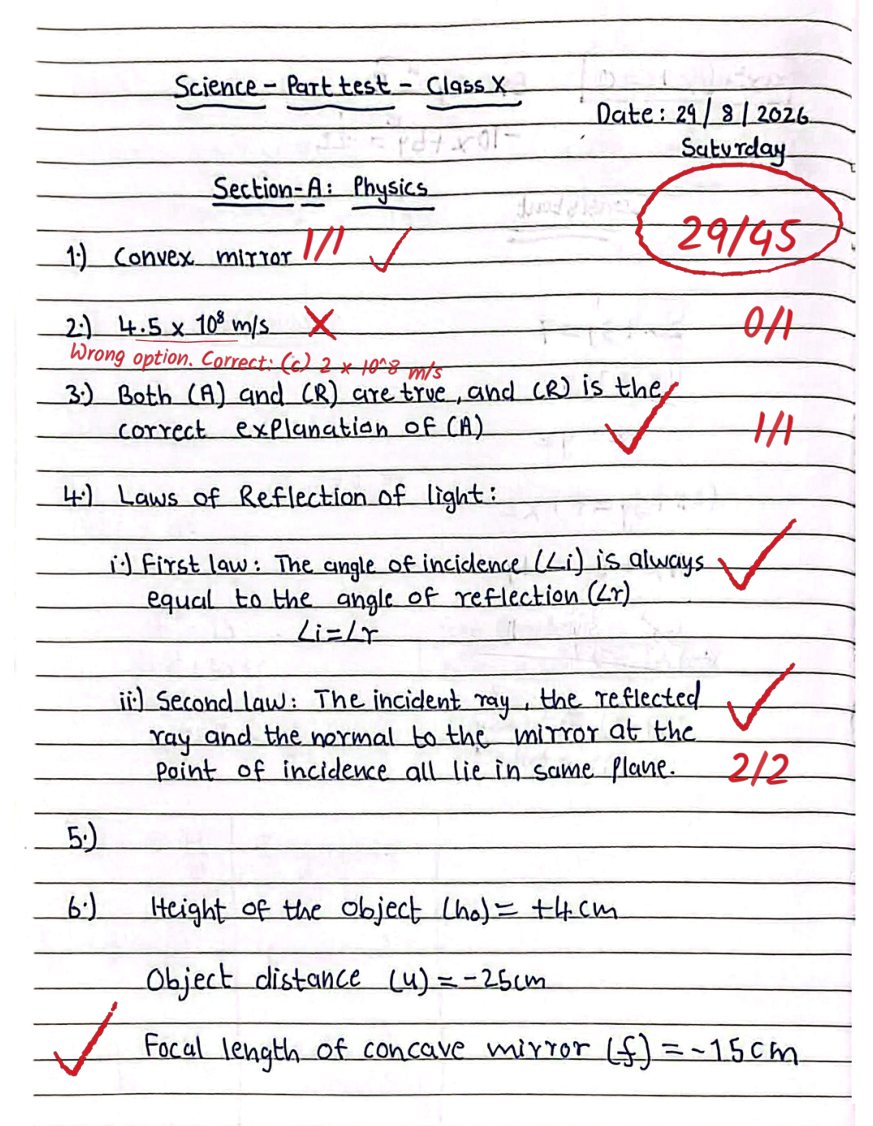
The student's own copy comes back with ticks, marks and a short note where marks were lost, so they can see what went wrong and what to fix.
- 05
Teacher reviews & approves
Teachers stay in control. They check the AI's marks, change any mark on the review page or on the copy, and approve the final result. The AI never overwrites a teacher's edit.
- 06
Release results faster
Once approved, results and feedback go to students: straight away, after the test window closes, or when the teacher decides.
From answer sheet to result, automatically
How fast is it? In Vacademy's own pilot, a five-page copy with 21 questions was evaluated in under five minutes. Bulk checks run in the background: 100 copies take roughly two to three hours, while teachers are teaching.
Two honest limits. If your mock is all OMR bubbles and you already own an OMR scanner, your marks are fast already; the gain here is in written answers and in the notes. And copies are read in English today, so a Hindi-medium batch should ask before planning around it.
How AI Evaluation Helps JEE & NEET Coaching Institutes
The first gain is time. Checking that took Monday to Wednesday now runs in the background, so results can go out the same day. Teachers get those hours back for doubt sessions and revision classes.
Weekly JEE test
Results before the next class, not the next week.
NEET full-length test
Objective marks on submission; written parts checked the same day.
Chapter-wise test
Short, frequent tests stop being a checking burden.
Revision test
The same mistake across the batch shows up in the report.
Pre-exam mock
Feedback lands while there is still time to act on it.
The second gain is what you learn. Every copy is judged by the same criteria, so patterns show up. If 60 students lost the same step on one question, that is a topic to teach again, not 60 careless students. For student performance analysis, reports show strong and weak topics, rank and percentile within your batch, and the most-picked wrong option on MCQs.
To be clear, none of this raises a rank on its own. It gives students time to act on a result before the next test.
Manual vs AI-Assisted Evaluation
| Factor | Manual evaluation | AI-assisted evaluation |
|---|---|---|
| Teacher workload | Higher | Lower for repetitive work |
| Evaluation speed | Depends on teacher capacity | Runs in the background |
| Large batches | More difficult | Easier to scale |
| Teacher involvement | Full evaluation | Review and academic judgment |
| Feedback | Can be delayed | Can be delivered faster |
AI Does Not Replace Teachers
AI handles repetitive evaluation. Teachers handle academic judgment.
In a JEE or NEET year, one wrong mark matters to a student and their parents. So the teacher sets the marking scheme, reviews the AI's marks, corrects any that are wrong and approves the result. Nothing is released until then.
The AI does
- Reads every copy
- Applies the marking scheme
- Gives step marks
- Writes a note where marks were lost
- Adds up totals
The teacher does
- Sets the scheme and model answers
- Checks and corrects marks
- Decides doubtful cases
- Approves the results
- Chooses when students see them
What Institutes Should Look for in AI Grading Software
Whichever platform you compare, check these. Two matter most: grading should sit with your question banks and tests, and you should know where student copies are stored.
Take this to any demo, ours included.
- Reads handwritten answer copies
- Evaluates typed answers
- Uses your marking scheme
- Uses your model answers
- Checks a whole batch in one upload
- Teacher reviews every mark
- Marks can be edited
- You control when results go out
- Performance reports by topic
- Works inside your test platform
- Clear rules on student data
From Mock Test to Result, Faster
For coaching institutes, the hard part is not conducting tests. It is finishing the checking and feedback while the student can still use it. AI-assisted evaluation takes over the repetitive reading and adding, and leaves every decision with the teacher.
Vacademy puts this next to AI-powered question generation, online tests and reports, so the whole test cycle runs in one place. See all Vacademy features.
Try Vacademy's AI Evaluation
Explore Vacademy's AI Evaluation to see how your institute can streamline the journey from mock test to evaluated result.
Frequently Asked Questions
What is AI auto-grading for JEE and NEET mock tests?
It is software doing the first round of checking. It reads each student's answer, applies your marking scheme and model answers, gives marks question by question, and writes a short note where marks were lost. MCQs and numerical answers in online tests are marked on submission. A teacher reviews everything before results go out.
Can AI evaluate handwritten answer sheets?
Yes. In Vacademy, scanned PDF copies of handwritten answers are read by a vision model that handles normal student handwriting, crossed-out lines and working in the margin. If a copy is too faint or badly scanned to read properly, the system says so and flags it for a teacher instead of guessing. Copies are read in English today.
Can AI grading reduce teacher workload?
It removes the most repetitive part: reading the same questions hundreds of times and adding up marks. Teachers still review the results, but they check marks and notes that are already there instead of starting every copy from zero. The time saved can go to doubt sessions and revision classes.
Can teachers review AI-generated marks?
Yes, always. Every question's mark and note appears on a review page, and the teacher can change any of them, or edit the marks directly on the checked copy. The AI never overwrites a teacher's edit, and results reach students only when the assessment's release rule allows it.
How can coaching institutes automate mock-test evaluation?
Run objective sections online so they are marked on submission. For written sections, scan the answer copies as PDFs and upload the batch together, up to 200 copies at a time in Vacademy. Set the marking scheme and model answers once per paper. Then review the AI's marks and release the results.
How does AI help deliver faster exam results?
Checking runs in the background while teachers teach. In Vacademy's own pilot, a five-page copy with 21 questions was evaluated in under five minutes, and a batch of 100 copies takes roughly two to three hours. Results and reports can then go out the same day, after a teacher's review.