Executive Summary
Most software companies grow their domain authority on the backs of their customers: a “powered by” footer, a shared subdomain, a logo wall, a named case study. Each of those is a link, and links are how search engines decide who is credible. A genuine white-label vendor forfeits all of them, by design. This post explains the trade honestly — what we give up, why we still think it is the right call, what we do instead to earn authority, and what a buyer should actually infer from a vendor's link profile.

1. Where a Normal SaaS Company Gets Its Links
If you audit almost any established B2B software vendor, a large share of its referring domains trace back to its own customers. The mechanisms are consistent across the industry:
- The “powered by” footer. A link on every page of every customer's site. One customer with a busy site can be worth more than a year of content marketing.
- Shared subdomains. When customers are hosted at customer.vendor.com, every link anyone makes to that customer accrues to the vendor's domain.
- Vendor-branded app store listings. One listing covering many customers, ranking for all of their brand searches.
- Logo walls and named case studies. Customers link back to the case study that features them; the vendor ranks for the customer's name.
- Email and notification footers. Vendor branding on transactional mail, which drives branded search even when it does not create a link.
- Marketplace and directory listings that name the customers a vendor serves.
None of these are illegitimate. They are the standard playbook, and they work. The point is simply that they all share one requirement: the customer's audience must be able to see who built the software.
2. Why Every One of Those Is Closed to Us
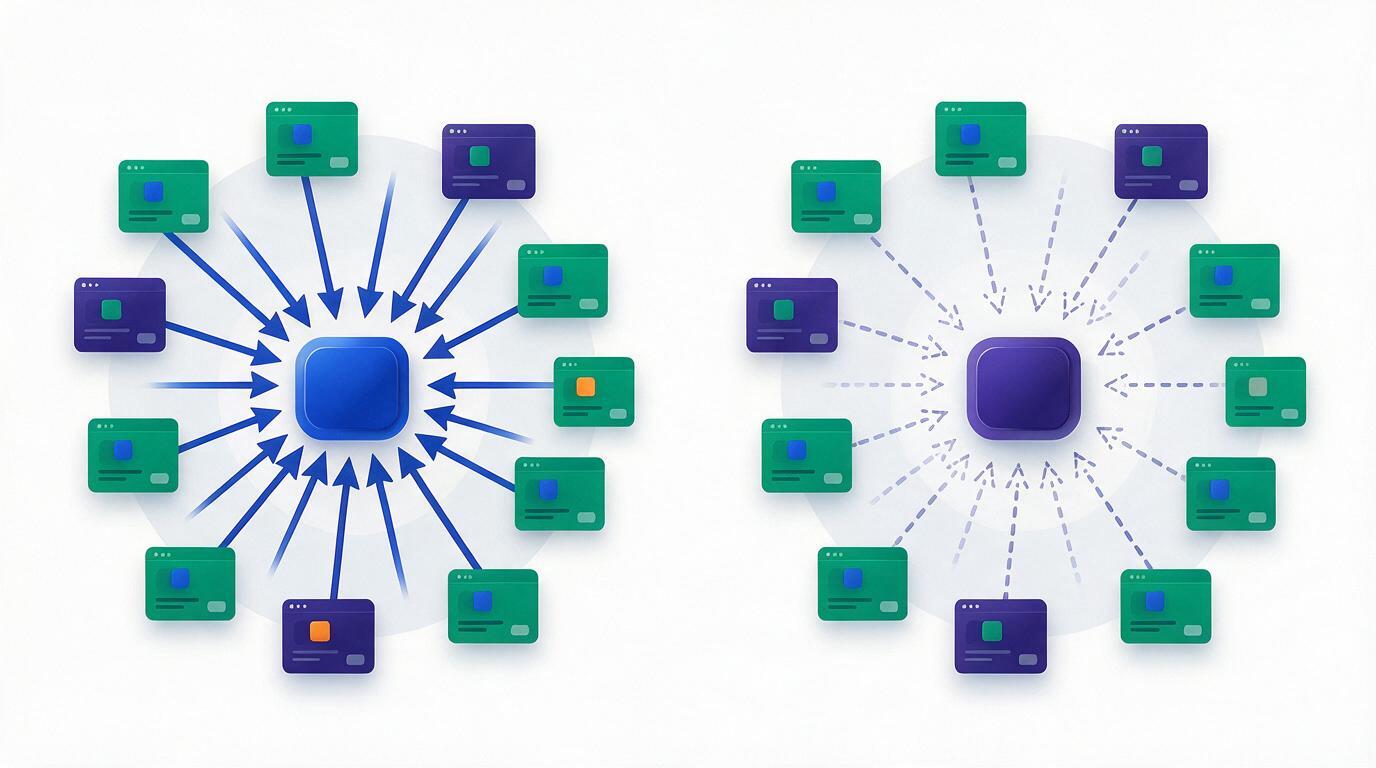
An institute buying a white-label platform is buying the right to be the only brand its learners ever see. Every mechanism in the list above violates that directly. So when we say the platform is white-labelled, the practical consequences for our own marketing are specific and unavoidable:
- • Backlinks from every institute running on the platform
- • Domain authority pooled from customer subdomains — they use their own domains
- • Ranking for our customers' brand names
- • A public logo wall and named case studies
- • Referral traffic from learner-facing surfaces
- • App store presence aggregated across customers
- • Every link, review and mention accrues to their domain, not ours
- • Their own app store listing under their own developer account
- • Learners who cannot discover — or be marketed to by — the vendor
- • No competitor learning their tech stack from their footer
- • Pricing conversations undistorted by a visible platform's public rates
- • Their brand equity compounding on their own asset
It would be dishonest to frame this as pure upside. Forfeiting customer backlinks genuinely slows organic growth, and it means we compete for search visibility against companies who get that authority handed to them by their users. We accept it because the alternative — asking an institute to display our name to its own students in exchange for our SEO — is charging them in brand equity for something they already paid money for. But the cost is real, and it is ours, not a marketing position.
3. The Degrees of White-Label — and Where Most Vendors Actually Sit
“White-label” is used loosely enough to be almost meaningless in a sales conversation. It is more useful to think of it as a scale, because a vendor's own link profile is often a reliable indicator of where they really sit on it:
| Level | What the learner sees | Vendor gets links? |
|---|---|---|
| Skinned | Vendor domain, vendor app, your logo in the header | Yes — heavily |
| Subdomain | yourname.vendor.com, shared app listing | Yes — all authority pools to them |
| Branded | Your domain and app, but vendor named in footers, emails or T&Cs | Partially |
| Fully white-label | Your domain, your app under your developer account, your sender identity, no vendor mention anywhere learner-facing | No — by design |
This is why a thin backlink profile is a genuinely informative signal when you are evaluating a white-label claim. A vendor that promises full white-labelling and has hundreds of referring domains from institutes in your sector is telling you two things that cannot both be true. Check the footers of the customers they name.
4. What We Do Instead
Giving up customer-derived links does not mean giving up on being findable. It means authority has to be earned from sources that do not require anyone to reveal what they run on:
- Writing the operational detail nobody else publishes. The reconciliation checks before a platform migration, how to read a counsellor-by-segment conversion matrix, where handwriting recognition breaks in AI evaluation. This is what earns a citation on merit.
- Consent-based, anonymised customer evidence. Where an institute is willing to be named, we name them. Where they are not — which is most of the time, because being publicly identified as running on a platform partly defeats the point — the numbers appear without the name.
- Directories, marketplaces and review platforms, where the listing is ours to make and does not depend on a customer crediting us.
- Comparison and category pages, which rank on their own substance rather than on borrowed authority.
- Being useful to answer engines. Structured, self-contained answers on the operational questions institute owners actually ask. An answer engine citing a clear explanation does not need a backlink to do it.
If an institute wants to be public about the platform behind their operation — some do, particularly when the technology is part of how they differentiate — we are glad to work with them on it. The rule is not “we hide.” The rule is that the choice belongs to the institute, and the default is invisible. A vendor whose default is visible has quietly made that decision on your behalf.

5. What a Buyer Should Actually Take From This
Domain authority is a proxy for trust, and like most proxies it measures something adjacent to what you actually care about. For a white-label purchase specifically, it can be close to inverted. Some more useful questions:
- Look at their customers' footers, not their backlink count. Ask for two or three live institute sites running on the platform. If you cannot tell from the site, the app store listing or the transactional emails who built it, the claim holds.
- Ask for references rather than logos. A vendor who cannot show you a logo wall should still be able to arrange a call with a comparable institute. Confidentiality about branding is normal; inability to produce any reference at all is not.
- Trial on your own data. Two to three months of your real leads, calls, admissions and payments will tell you more in a week than any amount of third-party validation.
- Read the contract on ownership and exit. Who owns the developer account, the domain, the data, and what happens on termination. This is where white-label claims are actually enforced or exposed.
- Judge the public writing on its merit. If a vendor cannot explain the operational detail of your problem clearly in public, the absence of backlinks is the least of the concerns.
We would rather be harder to find and completely invisible to your students than easy to find because our name sits in your footer. If that trade seems reasonable to you, it is probably the right basis for a working relationship. If it does not, that is genuinely useful to know before either of us spends time on it.
Judge it on your own data
We will show you live institute deployments where you cannot tell who built the software, and load two to three months of your own historical records so you can assess the platform rather than the marketing.