Key takeaways
- LMS stands for learning management system: software that keeps an institute's courses, tests, students and results in one place.
- It does not replace the teacher. It takes over the finding, tracking and repeating around the teaching.
- In 2026, expect more than video storage: a good phone experience, your own brand, AI that a teacher controls, clear data rules and a price you can work out.
- A single small class may not need one yet. The need usually starts with the second batch or the second teacher.
Picture a coaching center in Kanpur on a Monday evening. The physics notes are somewhere in a WhatsApp group with 400 unread messages. Attendance is in a register. Last week's test marks are in an Excel file on one teacher's laptop.
Then a father calls and asks, “How is my son doing in physics?” A simple question. It takes twenty minutes and two phone calls to answer. An LMS exists for that twenty minutes.
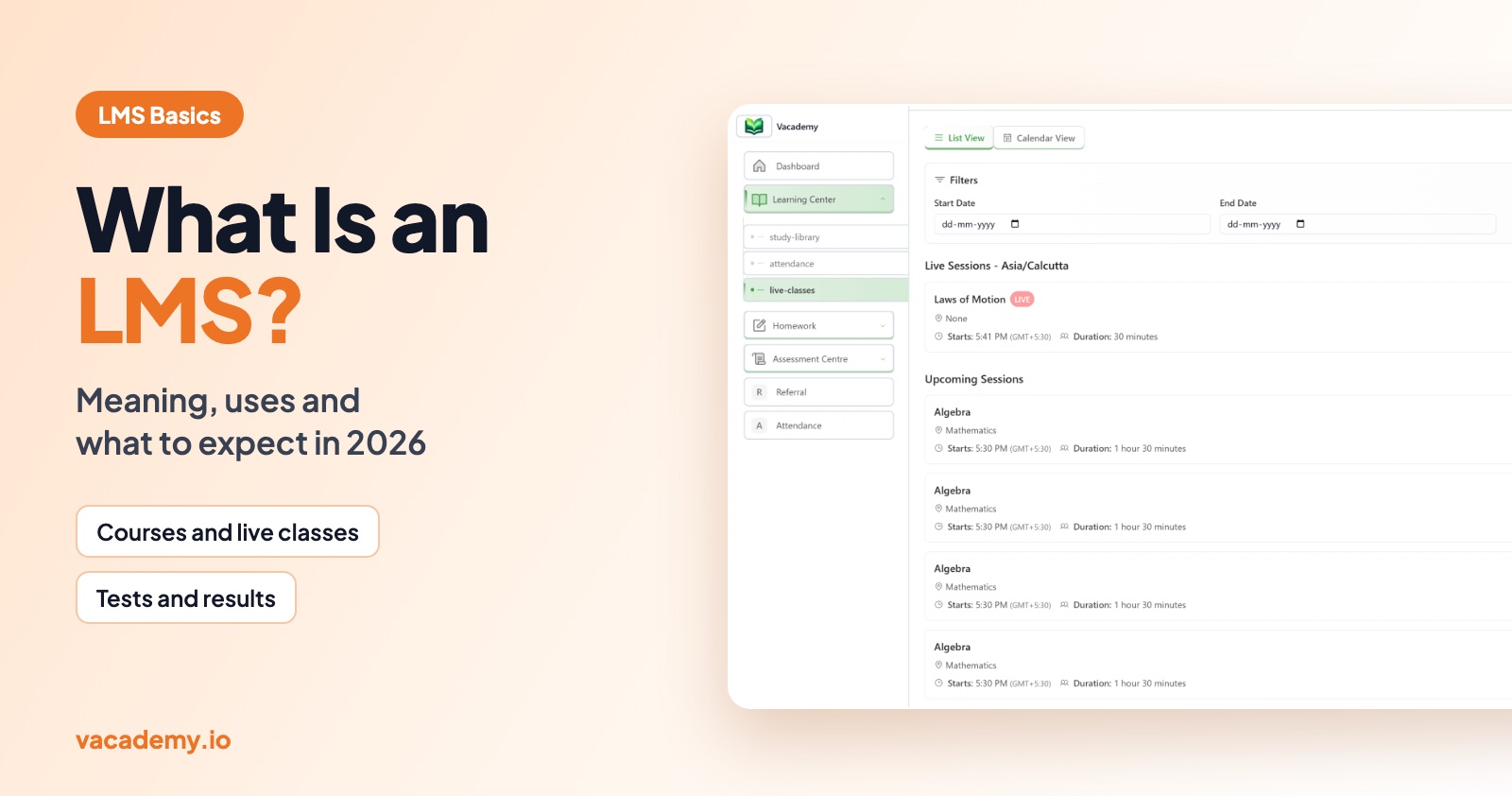
What Is an LMS, in Simple Words?
LMS stands for learning management system. It is software, on the web and usually in an app, where an institute keeps its courses, runs its classes and tests, and tracks how each student is doing.
Think of your institute's library, exam hall, notice board and office register, all behind one login. Teachers use it to teach and check. Students use it to learn. Owners use it to see what is really happening without asking five people.
At a glance
What moves into an LMS
A general picture. Exact features differ from one LMS to another.
What Does an LMS Do? Six Everyday Jobs
Holds your courses
Videos, PDFs, notes and quizzes, arranged by subject and chapter.
Organizes students
Add one student or a full list from a spreadsheet, then place them in batches.
Runs live classes
Schedule the class, share the link, and see who came and for how long.
Conducts tests
Exams with a fixed time window, mock tests and practice sets, with results in one place.
Handles doubts
A question asked from a lesson reaches the right teacher and does not get lost.
Shows progress
Which student is falling behind, and which chapter a whole batch finds hard.
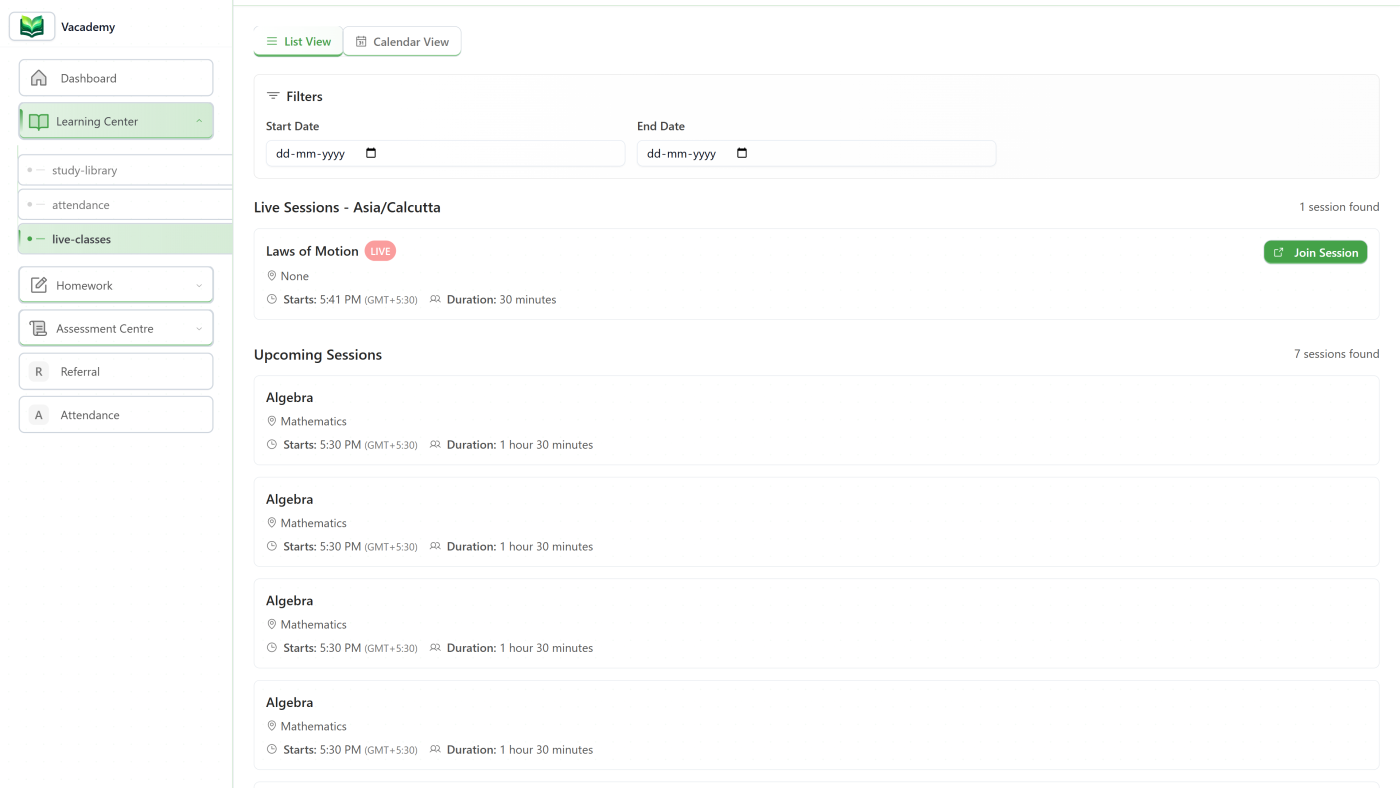
Here is how that looks in one week. On Monday, the physics teacher uploads the Laws of Motion notes and sets a test for Friday. On Tuesday, the 5:30 batch joins the live class, and attendance is recorded on its own. On Friday, sixty students take the test.
By Saturday, the teacher can see that twenty of them got the friction questions wrong. That is one student in three, so it is not twenty weak students. It is one topic to teach again, and next Tuesday's class starts there.
Types of LMS, and Which One Fits
“LMS” covers very different products, so check which type you are buying.
Simple classroom tool
e.g. Google Classroom
Open-source LMS
e.g. Moodle
Course-selling platform
Built for solo creators
All-in-one institute platform
e.g. Vacademy
For side-by-side detail, read Vacademy vs Google Classroom or Moodle vs Vacademy.
LMS, ERP and CRM: Three Words People Mix Up
An LMS runs the learning. An ERP runs the office, such as fees, staff and records. A CRM runs admissions, from the first enquiry until the student joins. Many institutes now want these connected, so that nobody types a new student's details twice. Our LMS vs ERP vs CRM guide goes deeper.
What to Expect From an LMS in 2026
Storing videos is the minimum now. India has about 958 million active internet users, nearly 57% of them in rural areas, says the IAMAI-Kantar Internet in India Report 2025. About 44% have used AI features such as chatbots or voice search, and that rises to 57% among 15 to 24 year olds. Your students arrive with these habits. Here are seven things to expect, and one question to ask a vendor for each.
1.It works properly on a phone
A student in a small town should be able to watch a lesson, take a test and ask a doubt from a phone, on a weak network.
Ask: Can students save lessons to watch later? What happens to a test if the network drops?
2.It carries your name
Students should see your logo, your web address and your app on the Play Store. This is called a white-label LMS. Your name is what parents trust.
Ask: Whose name appears on the app, the emails and the certificates?
3.AI saves teacher time, and the teacher stays in charge
AI can now draft a course outline, make questions from a chapter and check answer copies. These drafts still make mistakes, so a teacher must review them.
Ask: Can a teacher change or reject every AI result before students see it?
4.Doubts are answered from your own notes
A general chatbot can give an answer that does not match your syllabus. A better one answers from your material and shows where the answer came from.
Ask: Does it name the source page? What happens when it does not know?
5.Reports people actually read
An owner should see a weak batch without opening Excel. A parent should get a report without calling the teacher.
Ask: Show me the report for one batch and one student. Can it go out on WhatsApp?
6.Clear rules for student data
Most school and coaching students are under 18, and India's data law counts them as children. The DPDP Rules, notified in November 2025, ask for a parent's permission before a child's data is used, with some exceptions for an educational institution's teaching and safety work. The main duties are due to start around May 2027. Dates can change, so confirm them with your lawyer.
Ask: Who collects the parent's permission, you or us? Can we export and delete a student's data?
7.A price you can work out
Vendors charge per student, by the year, or as a share of your fees. Compare the total, not the headline number.
Ask: What is the full yearly cost at 500 students, with GST? Do you take a share of fees?
Does Your Institute Need an LMS Yet?
If you teach 25 students in one room and know each of them by name, you can probably wait. Otherwise, count how many of these sound familiar.
Six signs
- You run more than one batch, or have more than one teacher.
- Students keep asking for notes that were already sent on WhatsApp.
- Test marks live in one person's Excel file.
- Attendance eats the first five minutes of every class.
- You cannot answer “how is this student doing?” within a minute.
- A student can stop coming for weeks before anyone notices.
Three or more? The problem is costing you time every week.
How Much Does an LMS Cost?
The total depends on your student count and how the vendor charges. Add the extras too: the app, the setup, moving your old data, and support. For comparison, Vacademy plans start from ₹3,000 a month before GST, priced by the number of learners. There is no share of your fees and no setup fee, and moving your data is free.
Where Vacademy Fits
We built Vacademy for institutes that have outgrown WhatsApp and Excel. Courses, live classes, tests, doubts, fees and admissions share one system, under your own name, with no “Powered by Vacademy” anywhere.
The AI doubt chatbot answers from your own material, names the source page and hands over to a mentor when needed. AI copy checking reads handwritten answer sheets written in English, and no result goes out until a teacher releases it.
Try It on One Batch
Bring one course and one batch. In a 30-minute demo, we will show you how your own week would look.
Frequently Asked Questions
What is the full form of LMS?
LMS stands for learning management system. It is software where an institute keeps its courses, runs classes and tests, and tracks the progress of each student.
What is an LMS used for in education?
Schools, coaching centers and colleges use an LMS to share notes and videos, run live classes, mark attendance, conduct tests, answer doubts and see reports on each student and batch.
What are some examples of an LMS?
Moodle, Google Classroom, Canvas and Vacademy are all used as learning platforms, but they are quite different. Moodle is open source and needs someone to run it. Google Classroom is a simple classroom tool. Vacademy also covers admissions, fees and your own branded app.
What is the difference between an LMS and an ERP?
An LMS runs the learning: courses, classes, tests and progress. An ERP runs the office: fees, staff and day-to-day records. A CRM is a third system, which handles admissions enquiries before a student joins.
Is an LMS only for schools?
No. Coaching centers, colleges, skilling centers, publishers and company training teams all use one.
How much does an LMS cost in India?
It depends on the number of students and how the vendor charges. Vacademy plans start from ₹3,000 a month before GST, with no share of your fees and no setup fee.
How do I choose the right LMS for my institute?
Start with the problem that costs you the most time today. Ask each vendor the same questions on phone use, branding, AI, data rules and total price. Then run one real batch before you move everyone.