Every learning organisation has a story about the trainer who left. The senior who carried the difficult subject. The coach the parents trusted. The trainer whose batch always topped the exam. When they leave, the organisation suddenly realises that an enormous amount of know-how was sitting in one person's head, and now it is gone.
The instinct after this happens is to write a few SOPs and move on. It rarely works. The next time a key trainer leaves, the same shock returns. The pattern is not bad luck. It is the absence of knowledge continuity as a designed capability.
This piece walks through what actually gets lost when a star trainer leaves, why it keeps happening, and the Vacademy approach to making continuity a built-in feature of how your organisation runs.
Six Things That Walk Out the Door With a Star Trainer
Each one looks small. Together they explain why quality drops so visibly after a senior departure.
Lecture Patterns Walk Out the Door
How the trainer opens, transitions, gives examples, summarises, none of it is captured. The new trainer rebuilds from scratch.
Calibrated Question Banks Are Lost
The senior trainer's question style and difficulty calibration was their own. The new trainer's questions feel different, learners notice.
Doubt Patterns Are Forgotten
Common confusions, FAQs, the rephrasings that worked, all sat in the trainer's WhatsApp and inbox. They leave with them.
Relationship Context Disappears
Which learner needed extra encouragement, which parent expected weekly updates, which cohort was struggling. Lost the day the trainer leaves.
Operational Tricks Are Untransferable
The trainer's shortcuts, batch playbooks and timetable hacks were never documented. The new trainer reinvents poorly.
Quality Reputation Takes a Hit
Parents and learners feel the difference in week two. Word travels in WhatsApp groups within a month. Renewals dip a term later.
Lecture Plans Belong to the Organisation, Not the Trainer
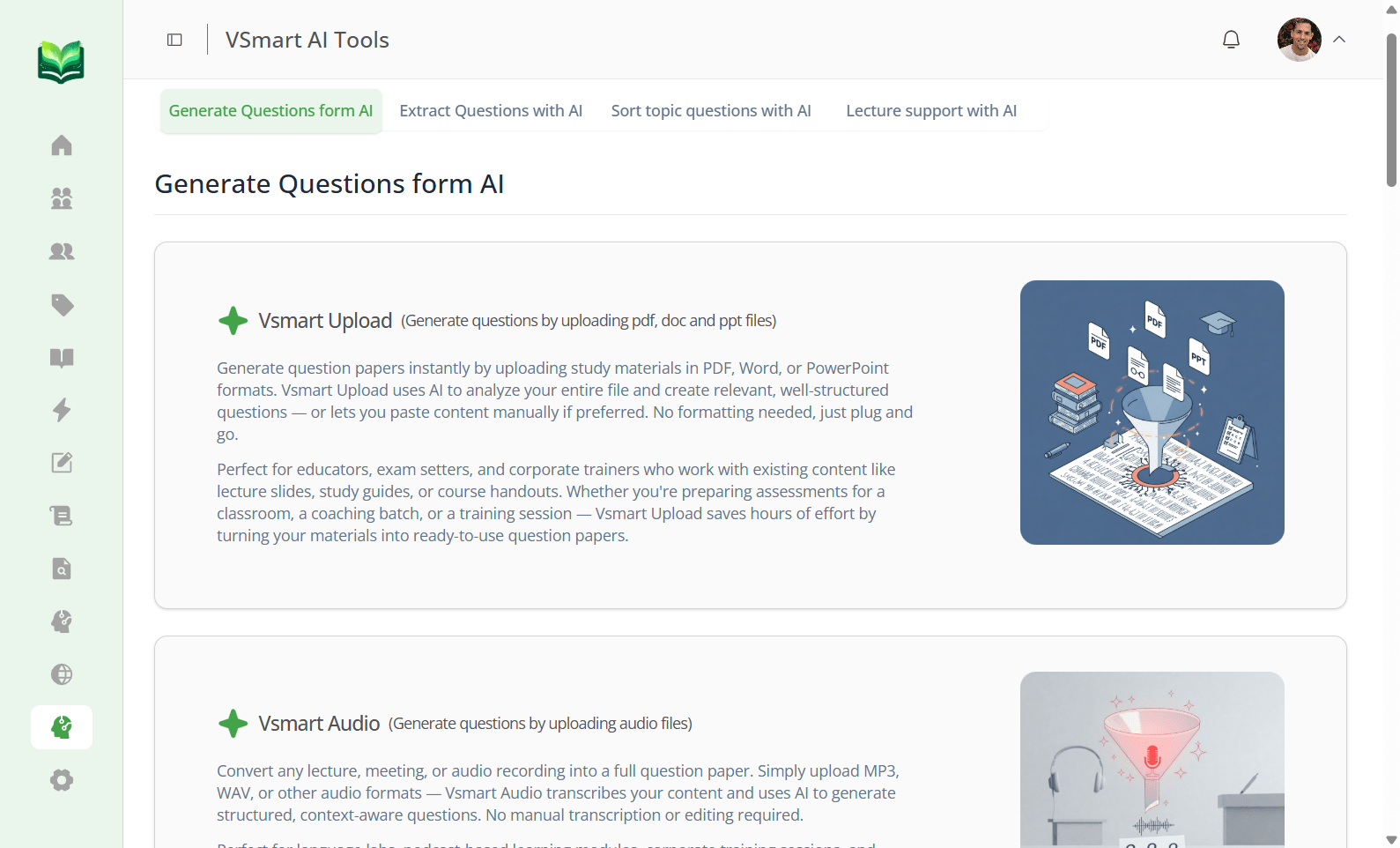
When lecture plans, examples and slide drafts sit inside Vsmart Lecturer, a new trainer onboards by stepping into structure, not by guessing what their predecessor used to do. Continuity becomes a property of the system, not a hope.
Vulnerable Versus Continuity-Ready
Where each kind of knowledge actually lives in two different operating models.
| Knowledge Type | Vulnerable Organisation | Continuity-Ready on Vacademy |
|---|---|---|
| Lecture plans | Trainer's personal notes | Structured plans saved inside Vsmart Lecturer |
| Question banks | Word documents on a personal laptop | Centralised question banks with Vsmart Topics |
| Past sessions | Recordings nobody finds | Indexed library accessible to new trainers and absent learners |
| Doubt patterns | Scrolled past in WhatsApp | Tracked doubt module with reusable answers |
| Learner context | In the trainer's head | Profile with attendance, performance and engagement history |
| Operational rhythm | Tribal knowledge | Documented templates and workflows inside the platform |
Doubt Histories Become Institutional Memory
When learner doubts and the trainer's resolutions are tracked inside Vacademy, the next trainer inherits an instant library of how common confusions were handled. Months of tribal knowledge become first-day access.
Six Pillars of Continuity-Ready Operations
Each one moves knowledge out of an individual's head and into the platform.
Documented Lecture Library
Structured plans stored inside Vsmart Lecturer that any new trainer can read, edit and deliver from.
Reusable Question Banks
Vsmart Topics produces calibrated question banks per chapter that survive any trainer transition.
Indexed Live Recordings
Every live session captured automatically, searchable, and available to onboarding trainers.
Structured Doubt History
Every doubt and resolution stays in the doubt module, becoming an institutional memory new trainers can use.
Full Learner Profiles
New trainers see attendance, performance, engagement and notes for every learner the moment they step in.
Templated Operations
Reminders, parent updates and follow-ups run on platform templates, not on any individual's habit.
Continuity Is a Choice, Not Luck
Organisations that handle trainer transitions gracefully do not have luckier replacements. They had built continuity into how they store knowledge years before the transition arrived. By the time a key trainer left, the institution already owned what it needed to keep going.
Vacademy is built so that storing knowledge in the system is the path of least resistance. Trainers prefer it because it saves them time. Leaders gain because the institution becomes resilient.
Make Your Institution Trainer-Transition Proof
Walk through your continuity exposure with the Vacademy team. We will help you move trainer-trapped knowledge into a resilient system over the next quarter.
Frequently Asked Questions
Will trainers see this as surveillance?
Done well, it feels like support, not surveillance. Vsmart Lecturer saves them an evening of planning each week. Trainers usually become the strongest advocates within the first cohort.
Can we capture the style of a senior trainer who already left?
Partially. Past recordings, past question papers and past notes can be uploaded to Vsmart Upload to extract structure. Future trainers reduce the risk.
How does this affect hiring?
It makes hiring dramatically easier. New trainers step into structured workflows, lecture plans and learner context, so onboarding compresses from quarters to weeks.
Is continuity only relevant for big institutions?
It is most acute for mid-sized ones, where each senior trainer covers a disproportionate share of quality. Vacademy especially helps the 200 to 5000 learner segment.
How fast does continuity readiness show up?
Most institutions feel a noticeable difference within the first cohort, and the difference compounds with every retained workflow, recording and template.