Picture this: It's 8 AM, and you have a live class at 9. Before you can teach, you need to log into your LMS, set up a Zoom link, share it on your WhatsApp group, check if payments are cleared in Razorpay, and mark yesterday's attendance in a spreadsheet. Welcome to fragmented online teaching.
The modern educator doesn't just juggle subjects—they juggle platforms. And this juggling act has real consequences: burnout, inefficiency, and ultimately, compromised learning outcomes. Let's explore why platform fragmentation is the silent killer of effective online education.
The Typical Educator's Tech Stack (Chaos Edition)
The Hidden Cost of Fragmentation
Every disconnected tool creates friction. Here's how this friction compounds into serious problems.
Time Drain
Teachers spend 40%+ of their time on administrative tasks across multiple platforms instead of actual teaching.
Hidden Costs
Each tool has its own subscription, integration cost, and learning curve. The total often exceeds unified platform pricing.
Student Confusion
Learners struggle to navigate between platforms, leading to missed classes, lost assignments, and poor engagement.
Integration Nightmares
Connecting tools requires technical expertise, often breaks, and creates data silos that prevent meaningful insights.
Fragmented vs. Unified: A Day in the Life
See how the same tasks transform when you move from multiple tools to a unified platform.
Scheduling a Live Class
Create event in calendar → Set up Zoom link → Share link on WhatsApp → Update LMS → Email reminder → Manual attendance tracking
One click: Schedule in platform → Auto-generates link → Auto-notifies students → Auto-marks attendance
Collecting Payments
Generate invoice → Share payment link → Track in spreadsheet → Manual confirmation → Update access in LMS
Built-in payment → Auto-confirms → Auto-grants access → Real-time dashboard
Tracking Progress
Export from LMS → Cross-reference with attendance → Check assignment submissions → Compile in spreadsheet
Single dashboard with real-time progress, attendance, and performance analytics
What If Everything Just Worked Together?
Imagine logging into one platform where your courses, live classes, payments, communication, and analytics all live together. No more context switching. No more data silos. No more chaos.
- Single dashboard for all operations
- Automated workflows that save hours
- Real-time student insights across activities
- Built-in payments and communication
- AI-powered content creation tools
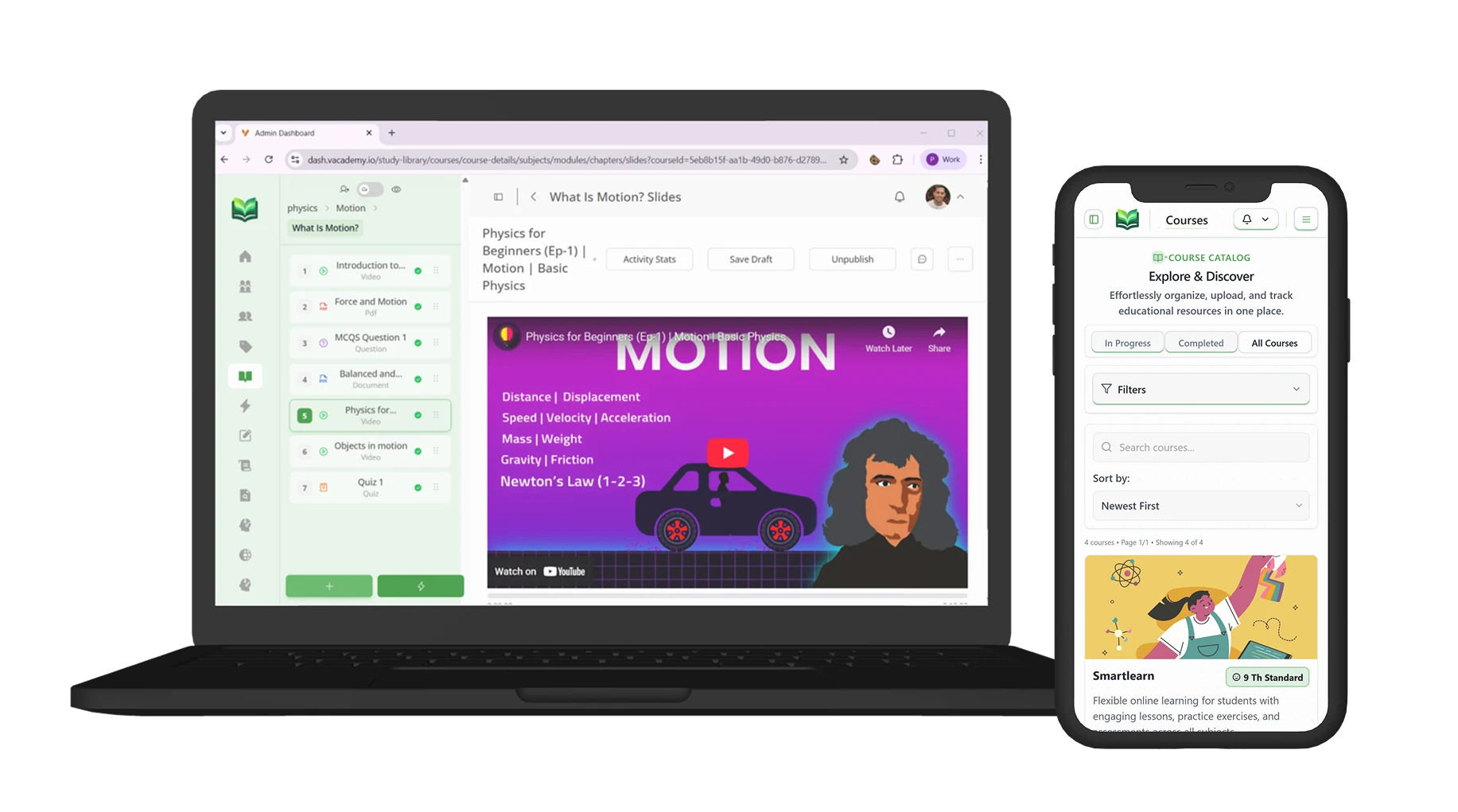
Automation That Ends the Chaos
Watch how a unified platform automates the tedious tasks that fragment your day.
5 Warning Signs Your Teaching Stack is Broken
The Unified Alternative: One Platform, Zero Chaos
What if you could replace your fragmented stack with a single, intelligent platform that handles everything—from course creation to payments, live classes to analytics?
What Educators Gain with a Unified Platform
We were using 7 different tools to run our coaching institute. Switching to a unified platform cut our admin time in half and our students finally stopped asking ‘where do I find the recording?’
Ready to End the Chaos?
See how Vacademy unifies your entire teaching operation into one intelligent platform. No more juggling. No more chaos. Just teaching.
Frequently Asked Questions
Why is platform fragmentation a problem for online educators?
Fragmentation forces educators to juggle multiple tools, each with its own login, interface, and data silo. This leads to wasted time on admin tasks, student confusion about where to find materials, inconsistent data that prevents meaningful insights, and cumulative subscription costs that often exceed unified platform pricing.
How much time do educators waste on fragmented platforms?
Studies show educators spend 40% or more of their work time on administrative tasks when using fragmented tools. This includes logging into multiple systems, manually syncing data, copying links between platforms, and troubleshooting integration issues. A unified platform can reclaim 10+ hours per week.
Can't I just integrate my existing tools?
While integrations exist, they often fail, require technical expertise to set up, and still don't provide a unified experience. Data still lives in silos, and you're managing multiple subscriptions. A purpose-built unified platform provides seamless workflows, consistent data, and lower total cost.
What tools does a unified teaching platform replace?
A comprehensive unified platform like Vacademy replaces your LMS, video conferencing tool integrations (with native Zoom/Meet/YouTube), payment gateway, communication tools (email + WhatsApp automation), analytics dashboards, and even some content creation tools with AI features.
Will switching to a unified platform be disruptive?
Most unified platforms offer migration support to bring over your existing courses, student data, and content. The short-term transition effort is far outweighed by the long-term benefits: simplified operations, better student experience, and significant time savings.
How does Vacademy solve platform fragmentation?
Vacademy is designed as a Learning Operating System that combines LMS, live classes, payments, CRM, automation, and AI tools in one platform. Educators get a single dashboard for everything, automated workflows, integrated analytics, and built-in communication—eliminating the need for multiple disconnected tools.