Why Your LMS Choice Makes or Breaks Your STEM Company
The STEM education market is projected to exceed $120 billion by 2027. As robotics academies, coding bootcamps, and science training centers scale rapidly, the learning management system at the center of operations becomes the single most important technology decision.
The wrong LMS means fragmented workflows, manual data entry, and a ceiling on growth. The right one automates operations, engages students, and scales with you. We evaluated 10 platforms across six critical dimensions to help you choose wisely.
How We Evaluated These Platforms
Every platform was tested against six criteria that matter most for STEM education companies scaling in 2026.
STEM-Specific Tools
Does the platform offer features tailored for science, technology, engineering, and math instruction?
AI & Automation
How well does it leverage AI for content creation, grading, and operational tasks?
Live Class Integration
Native or third-party support for live sessions with Zoom, Meet, or YouTube Live?
Analytics & Reporting
Granular performance insights for students, batches, and overall institution health?
Pricing & Value
Cost-effectiveness relative to the feature set, especially for growing STEM companies?
Mobile Experience
Quality of the mobile app for students and administrators on the go?
The Top 10 LMS Platforms for STEM
Ranked by their overall suitability for STEM education companies in 2026, from best to most niche.
Vacademy
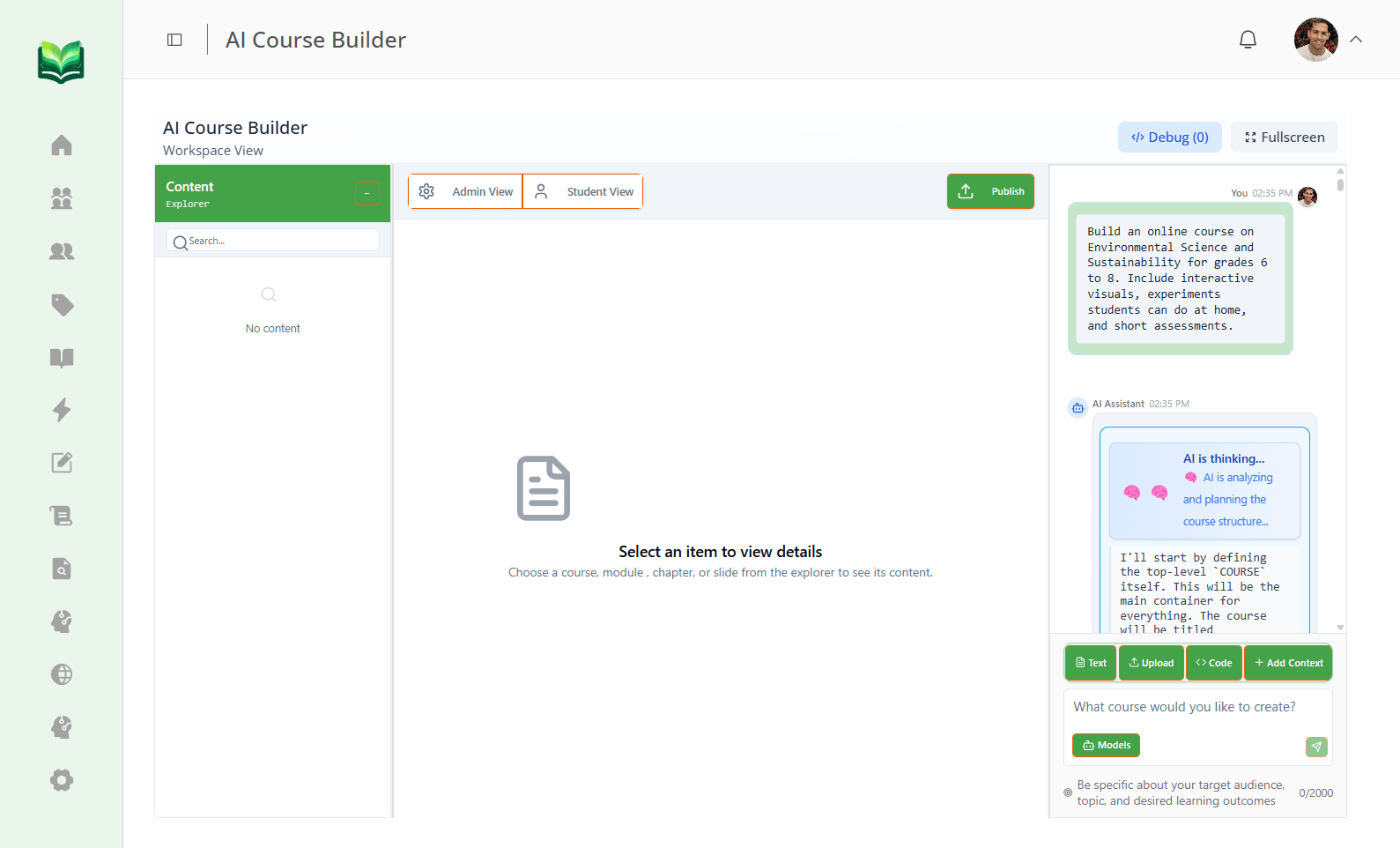
Best Overall for STEM EducationVacademy is an AI-powered education operating system built from the ground up for STEM education companies. Unlike generic LMS platforms that bolt on features as afterthoughts, Vacademy treats automation, AI content generation, and operational management as first-class citizens. Its Vsmart Upload converts PDF question papers into interactive quizzes using computer vision, while Vsmart Lecturer generates entire curriculum architectures from a single prompt. With built-in CRM, automated fee collection, branded mobile apps, and live class integration across Zoom, Google Meet, and YouTube Live, it eliminates the need for 5-6 separate tools. STEM companies scaling from 100 to 10,000+ students find Vacademy particularly valuable because every workflow is connected and intelligent.
Key Features
- Vsmart Upload: PDF-to-quiz conversion using computer vision AI
- Vsmart Lecturer: AI curriculum planner that generates full course structures
- Automated attendance tracking for live sessions with precise duration logs
- Built-in CRM with payment automation, fee reminders, and invoice generation
- Branded mobile app and website builder included out of the box
- Supports Zoom, Google Meet, and YouTube Live from a unified schedule
Limitations
- Newer platform with a growing community compared to decade-old alternatives
Moodle
Best Open Source OptionMoodle is the world's most popular open-source LMS, used by universities and organizations globally. It offers unmatched customization through plugins and has a massive community. However, it requires significant technical expertise to set up and maintain, making it better suited for institutions with dedicated IT teams.
Key Features
- Highly customizable with thousands of community plugins
- Strong quiz and assessment engine with multiple question types
- Active open-source community and extensive documentation
Limitations
- Steep learning curve; requires server management and technical setup
- No built-in AI tools or automation for content generation
Canvas LMS
Best for Clean User ExperienceCanvas by Instructure is known for its modern, intuitive interface and strong integration ecosystem. It is widely adopted in higher education and increasingly by K-12 institutions. The SpeedGrader feature and robust API make it developer-friendly, though pricing can be prohibitive for smaller STEM companies.
Key Features
- Intuitive modern interface with SpeedGrader for efficient grading
- Extensive LTI integrations and open API for custom workflows
- Mobile-friendly design with a solid student and teacher app
Limitations
- Enterprise pricing can be expensive for small to mid-size companies
- Limited built-in automation for operations like CRM or fee management
Google Classroom
Best Free OptionGoogle Classroom is the go-to free LMS for educators already embedded in the Google ecosystem. It excels at simplicity, making assignment distribution and collection straightforward. However, it lacks the depth needed for serious STEM education at scale and has no built-in payment or CRM features.
Key Features
- Completely free with seamless Google Workspace integration
- Simple assignment creation and Google Drive integration
- Easy adoption with minimal training required
Limitations
- Very limited assessment and quiz capabilities for STEM subjects
- No payment processing, CRM, or advanced analytics
Teachable
Best for Individual Course CreatorsTeachable is a popular platform for individual creators and small teams selling online courses. It offers clean course building tools and handles payments out of the box. While great for solo educators, it lacks the institutional features STEM companies need at scale, such as batch management and live class scheduling.
Key Features
- Built-in payment processing with flexible pricing options
- Clean drag-and-drop course builder with multimedia support
- Sales pages and basic marketing tools included
Limitations
- No live class integration or real-time session management
- Limited analytics and no CRM or student relationship tools
Thinkific
Best for Course Marketing & SalesThinkific positions itself as a course creation and marketing platform, making it ideal for STEM educators focused on selling courses online. Its marketing funnel tools, membership sites, and community features are strong. However, it is designed for course sales rather than full institutional management.
Key Features
- Advanced marketing tools including funnels, upsells, and coupons
- Community and membership site features for student engagement
- App store with third-party integrations for extended functionality
Limitations
- Not designed for managing live classes or institutional operations
- Lacks AI-powered content generation or quiz automation
TalentLMS
Best for Corporate STEM TrainingTalentLMS is a lightweight, cloud-based platform designed primarily for corporate training. It is quick to set up and offers gamification features that work well for employee upskilling in STEM domains. However, its academic features are limited compared to education-focused platforms.
Key Features
- Quick setup with a clean, no-frills interface
- Built-in gamification with points, badges, and leaderboards
- SCORM and xAPI compliance for standardized content
Limitations
- Limited academic features; not built for student-facing education
- Basic reporting compared to full education platforms
Docebo
Best Enterprise AI LearningDocebo is an enterprise learning platform that uses AI for content recommendations and personalized learning paths. It is powerful for large organizations but comes with enterprise-level pricing and complexity. STEM companies with 500+ learners and dedicated L&D teams benefit most from Docebo.
Key Features
- AI-powered content recommendations and personalized learning paths
- Robust reporting and compliance tracking for regulated industries
- Social learning features and content marketplace
Limitations
- Enterprise pricing puts it out of reach for most STEM startups
- Complex setup requiring dedicated admin resources
LearnDash
Best WordPress-Based LMSLearnDash is the most popular WordPress LMS plugin, offering deep customization for those already running WordPress sites. It is ideal for STEM bloggers and educators who want to add course functionality to an existing site. However, it inherits all WordPress maintenance overhead.
Key Features
- Deep WordPress integration with thousands of compatible plugins
- Drip-feed content and prerequisite course logic
- One-time license fee rather than monthly subscription
Limitations
- Requires WordPress hosting and ongoing maintenance
- No built-in live class, CRM, or mobile app features
Edmodo
Best for School-Level Social LearningEdmodo focuses on K-12 social learning with a familiar, social-media-like interface that students find engaging. It is best suited for school-level STEM programs rather than commercial training companies. Its simplicity is both its strength and its limitation for advanced use cases.
Key Features
- Social media-style interface that boosts student engagement
- Easy parent-teacher communication tools
- Free tier available for basic classroom management
Limitations
- Very limited for commercial STEM education companies
- No payment, CRM, or advanced assessment capabilities
Feature Comparison at a Glance
A side-by-side look at how the top four contenders stack up across the features that matter most for STEM education.
| Feature | Vacademy | Moodle | Canvas | Google Classroom |
|---|---|---|---|---|
| AI Quiz Generation | ||||
| Live Class Integration | ||||
| Automated Attendance | ||||
| CRM Built-in | ||||
| Mobile App | ||||
| STEM-Specific Tools | ||||
| Free Tier Available |
Why Vacademy Leads for STEM Education
While every platform on this list has its strengths, Vacademy was purpose-built for the exact challenges STEM education companies face in 2026.
Ready to Pick Your LMS?
Stop comparing spreadsheets. See why hundreds of STEM companies chose Vacademy as their all-in-one education operating system.
What you get with Vacademy:
- AI Content & Quiz Generator
- Branded App & Website
- CRM + Payment Automation
Frequently Asked Questions
What should STEM education companies look for in an LMS?
STEM companies should prioritize platforms with strong assessment tools (especially for technical subjects), live class integration for interactive sessions, AI-powered content generation to save time, and operational features like CRM and payment processing that help scale the business.
Is a free LMS like Google Classroom enough for a STEM business?
For hobby-level teaching, yes. But for a STEM education company that charges fees, manages batches, needs branded apps, and wants to scale beyond 100 students, free platforms lack critical features like payment processing, CRM, automated attendance, and advanced analytics.
How does Vacademy's AI quiz generation work for STEM subjects?
Vacademy's Vsmart Upload uses computer vision AI to scan uploaded PDF question papers, identify individual questions, options, and diagrams, then converts them into interactive digital quizzes. This is especially powerful for STEM subjects where manually digitizing equations and diagrams is extremely time-consuming.
Can I switch from Moodle or another LMS to Vacademy?
Yes. Vacademy supports bulk data imports for students, courses, and content. The support team assists with migration to ensure a smooth transition, typically completing the process within a few days depending on data volume.
What is the typical pricing range for these LMS platforms?
Pricing varies widely. Google Classroom and Moodle (self-hosted) are free. Teachable and Thinkific start at $39-$49/month. Canvas and Docebo use enterprise quoting. Vacademy offers competitive pricing with a free tier and scales based on student count, making it accessible for STEM startups and growing companies alike.