Every educational institution, training organization, and EdTech startup faces the same pivotal question: Should we build our own digital learning platform, buy a ready-made solution, or integrate multiple existing tools? The answer isn't one-size-fits-all—it depends on your resources, timeline, and long-term vision.
This comprehensive guide breaks down each approach, examining the true costs (not just the obvious ones), time-to-market implications, scalability considerations, and ultimately, which path delivers the best return on investment for different types of organizations. Whether you're a school, university, coaching institute, or corporate training team, this guide will help you make an informed decision.
Build vs. Buy vs. Integrate: At a Glance
| Factor | Build | Buy | Integrate |
|---|---|---|---|
| Initial Costs | $100K - $500K+ | $50 - $500/month | $200 - $2,000/month (multiple tools) |
| Time to Launch | 6-18 months | Days to weeks | 1-3 months |
| Technical Expertise Required | High (dev team needed) | Low (no-code setup) | Medium (API knowledge helpful) |
| Customization Level | Unlimited (own code) | Moderate (platform limits) | High (combine tools) |
| Ongoing Maintenance | High (continuous dev) | Low (vendor handles) | Medium (multiple vendors) |
| Scalability | Depends on architecture | Built-in, vendor-managed | Limited by weakest tool |
| Feature Updates | Manual (your team) | Automatic (vendor) | Varies by tool |
| Data Ownership | 100% yours | Varies (check terms) | Split across vendors |
Approach 1: Build Your Own Platform
Building a custom learning platform from scratch gives you complete control over every feature, integration, and user experience. It's the ultimate in flexibility—but comes with significant investment in time, money, and ongoing resources.
Advantages
- Complete ownership and control of code
- Unlimited customization possibilities
- No recurring SaaS subscription fees
- Potential competitive advantage with unique features
- Full data ownership and privacy control
Disadvantages
- Extremely high upfront costs ($100K-$500K+)
- Long development timeline (6-18 months)
- Requires dedicated engineering team
- Ongoing maintenance, security, and updates
- Technical debt accumulates over time
True Cost of Building (Often Underestimated)
Approach 2: Buy a Ready-Made Platform
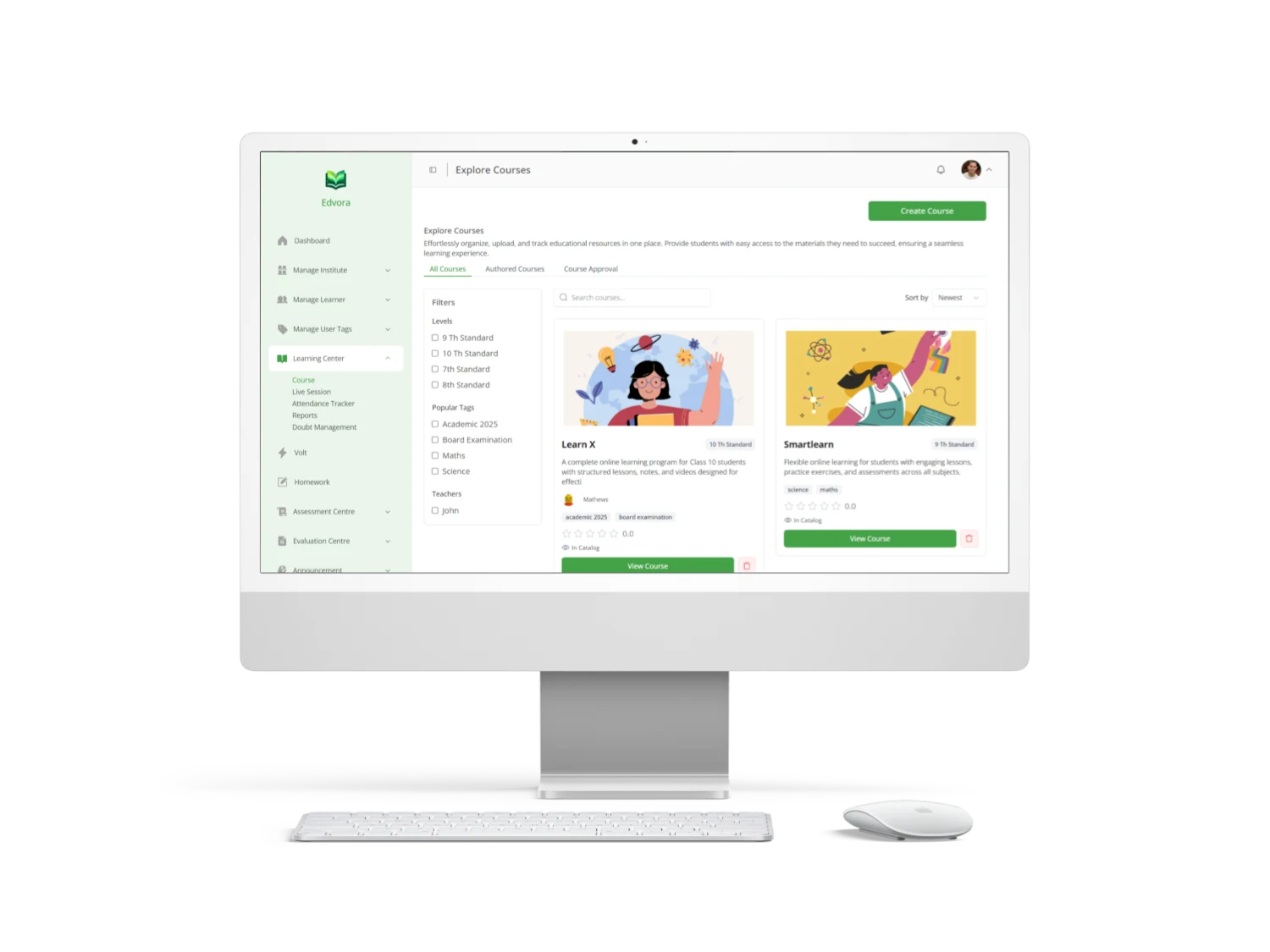
Buying a comprehensive learning management platform like Vacademy offers the fastest path to value. Modern platforms combine LMS, CRM, payments, automation, and AI features in one unified solution—eliminating the need to build or integrate multiple tools.
Why Buying is Often the Smartest Choice:
A modern all-in-one platform like Vacademy replaces 5-7 separate tools you'd otherwise need to build or integrate. It handles course management, live classes, assessments, CRM, payments, automation, and AI-powered content creation—all out of the box.
Advantages
- Immediate deployment (days, not months)
- No technical team required
- Continuous feature updates included
- Built-in AI and automation (Vacademy)
- Vendor handles security, hosting, compliance
- Predictable monthly costs
- Scalable pay-as-you-grow pricing
Considerations
- Customization within platform limits
- Dependency on vendor for features
- Recurring subscription costs
Approach 3: Integrate Multiple Tools
The integration approach attempts to combine specialized "best-of-breed" tools—using one platform for courses, another for payments, a third for CRM, etc. While this sounds flexible in theory, it often creates complex "Franken-stacks" that are difficult to maintain.
The Hidden Complexity of Integration
Each integration point is a potential failure point. Data sync issues, API changes, and version conflicts create ongoing maintenance headaches.
Advantages
- Use "best-of-breed" for each function
- Flexibility to swap individual tools
- Can leverage existing tool investments
- Start small and expand gradually
Disadvantages
- Integration maintenance is constant work
- Data silos and sync issues
- Multiple vendor contracts and support
- User experience isn't unified
- Higher total cost than perceived
The Real ROI Analysis
Let's compare the 3-year total cost of ownership for a mid-sized coaching institute (500-1000 learners):
Build Custom
Buy Platform
Integrate Tools
Buying saves 97%+ vs Building and 90%+ vs Integrating
These numbers don't even account for the faster time-to-market and opportunity costs of delayed launch.
Decision Framework: Which Path is Right for You?
Build If You Are...
- • An EdTech company where the platform IS your product
- • A large enterprise with $500K+ budget and 18+ month timeline
- • Have a dedicated engineering team of 5+ developers
- • Need truly unique features no platform offers
Buy If You Are...
- • A school, coaching institute, or training center
- • Want to launch within days or weeks
- • Don't have a technical team (or want to focus them elsewhere)
- • Need LMS + CRM + Payments + AI in one platform
- • Looking for predictable, scalable costs
Integrate If You Are...
- • Already heavily invested in specific tools you must keep
- • Have technical resources to maintain integrations
- • Have truly unique workflows no platform supports
- • Accept higher ongoing complexity and costs
Why Vacademy is the Smart Choice
Vacademy gives you the speed and simplicity of a ready-made platform, the power of AI and automation usually reserved for custom builds, and seamless integrations without the complexity.
- Launch in days, not months
- AI-powered course and assessment generation
- Built-in CRM, payments, and automation
- White-labeled mobile app included
- Pay-as-you-grow pricing
Frequently Asked Questions
How long does it really take to build a custom LMS?
A minimum viable product (MVP) typically takes 6-12 months with a dedicated team. A full-featured platform comparable to ready-made solutions can take 18-24 months. Factor in ongoing maintenance, bug fixes, and feature additions, and you're looking at a permanent development commitment.
What's the hidden cost of the 'integrate' approach?
Beyond subscription costs for multiple tools, you'll face: integration development ($20K-$50K), ongoing API maintenance as vendors update their systems, data synchronization issues (often requiring custom solutions), multiple vendor support conversations, and the cognitive load of managing disparate systems. Total hidden costs often exceed 50% of visible costs.
Can a 'buy' platform really replace custom-built solutions?
For 90%+ of educational institutions, absolutely yes. Modern platforms like Vacademy include features that would cost hundreds of thousands to build: AI content generation, advanced assessments, CRM, payment processing, live class integration, automation workflows, and analytics. The 'customization gap' is much smaller than people think.
What if I outgrow the platform I buy?
Quality platforms are designed to scale. Vacademy, for example, supports organizations from 50 to 50,000+ learners. Before committing, ask vendors about their largest customers, data export options, and API capabilities. The key is choosing a platform with enterprise-ready architecture from the start.
Should I build if technology is my competitive advantage?
Only if technology IS your product (i.e., you're an EdTech company selling platform access). If you're a school, coaching center, or training organization, your competitive advantage should be your teaching quality, not your technology infrastructure. Let a platform handle the tech so you can focus on education.
How do I migrate from an existing system to a new platform?
Most modern platforms offer migration support. Vacademy, for instance, provides bulk import tools for learners, content, and course structures, plus dedicated migration assistance. Plan for a 1-4 week transition period depending on data volume. The key is ensuring data export from your current system before committing to a switch.